ثبت نام / ورود
0
ثبت نام / ورود
0
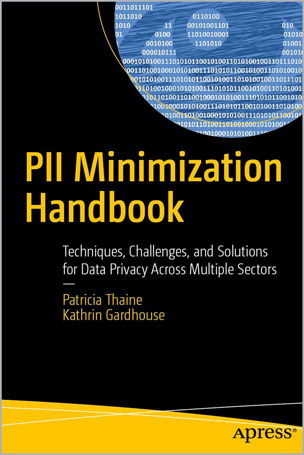
Techniques, Challenges, and Solutions for Data Privacy Across Multiple Sectors
Patricia Thaine, Kathrin Gardhouse
#PII
#Minimization
#Data
#Privacy
#Al
This book is a thorough and practical guide to minimizing personally identifiable information (PII) in every conceivable use case across Finance, Healthcare, Insurance, Legal, Marketing, HR, and Government.
Most data protection laws and regulations require that businesses only use as much PII as is required for each specific processing purpose. In some cases, processing is only permitted when the data is fully anonymized. Hence, PII Minimization describes a spectrum from redacting very few, if any, direct identifiers to full anonymization.
It is woefully unclear what exactly is required in terms of PII minimization. The feasibility and the degree of PII minimization crucially depend on what personal identifiers are present in the data set to be processed as well as the use case for processing it.
Industry- and use-case-specific PII-Minimization Standards supplies expert insights from academia as well as the seven industries to be covered. These experts clarify what personal identifiers are commonly present in the data sets collected by or otherwise available to them, what use cases for data processing are prevalent in their industry, and which personal identifiers are (un)necessary for each use case.
The book also features companies that are developing technological solutions to solve the difficult problem of data minimization. The practical insights to be gained here are how to achieve data minimization in specific use cases and with high accuracy to meet the regulatory requirements. As an example, for the development of facial recognition software, images of human faces must be used in machine-identifiable form. However, today’s technology can modify facial images for other use cases in such a way that they remain identifiable by human viewers but prevent the identification by automated systems.
You Will:
Who This Book is for:
Data protection regulators as well as risk officers, privacy and data protection officers, product leaders, cybersecurity officers, information officers, and data leaders within organizations operating in Finance, Healthcare, Insurance, Legal, Marketing, HR, and Government that collect or process PII for purposes that require certain personal identifiers to be removed or obfuscated to meet data minimization requirements. The book is also for regulators developing actionable data minimization standards for these seven industries.
Table of Contents
Section 1 : Data Minimization in Laws and Standards
Chapter 1: Data Minimization Under Different Jurisdictions
Chapter 2: Data Minimization Under Certain Standards
Section 2: PII Minimization and Artificial Intelligence
Chapter 3: Al Regulation and Data Minimization Throughout the Al System Life Cycle
Chapter 4: Data Minimization Challenges in General Purpose Al Models
Section 3: PII Minimization Techniques
Chapter 5: Minimization Techniques for Structured Data
Chapter 6: Minimization Techniques for Unstructured Data
Section 4: PII Minimization Across Different Sectors
Chapter 7: PII Minimization in Banking
Chapter 8: PII Minimization in Healthcare
Chapter 9: PII Minimization in the Pharmaceutical Industry
Chapter 10: PII Minimization in Insurance
Chapter 11: Pl I Minimization in Advertising
Chapter 12: PII Minimization in Government
Chapter 13: PII Minimization in Human Resources
Section 5: Developing Industry-Specific Standards and Best Practices
Chapter 14: Privacy by Design: The Origin of a Global Standard
Chapter 15: Data Minimization As a Foundation for Ethical Al Development: Navigating Global Legislative Convergence and Cultural Tensions
Patricia Thaine is the Co-Founder & Chairwoman of Private AI, a Microsoft-backed company whose technology enables organizations to detect, understand, redact, and anonymize their data at scale. Her R&D work focuses on privacy-preserving natural language processing, applied cryptography, re-identification risk, and maximizing the utility of data for AI and machine learning, the core challenges at the heart of PII minimization.
Patricia was named a 2023 Technology Pioneer by the World Economic Forum, and Private AI was recognized as a Gartner Cool Vendor in Privacy and won the Privacy Innovation Award at PICCASO 2024. She is a Vector Institute alumna, the co-inventor of a US patent, and brings over a decade of research and software development experience. Patricia hosts The Data Frontier podcast and was named to Maclean's Power List 2024 as one of the top 100 Canadians shaping the country.
Kathrin Gardhouse is Private AI's former Privacy Evangelist. She has since shifted into AI policy research with a focus on the EU and Canada. As a Senior AI Governance Associate at The Future Society and the Policy Lead of AI Governance and Safety Canada, she advises policymakers on risks from general-purpose and agentic AI and appropriate regulatory responses. As a Summer Research Fellow, she contributed to a legal commentary to the EU AI Act by the Institute for Law and AI, writing about the AI Office's enforcement powers. Kathrin is a lawyer by training and holds a philosophy PhD from McMaster University. She is certified by the IAPP as an Information Protection and AI Governance Professional.