ثبت نام / ورود
0
ثبت نام / ورود
0
Bertrand Meyer
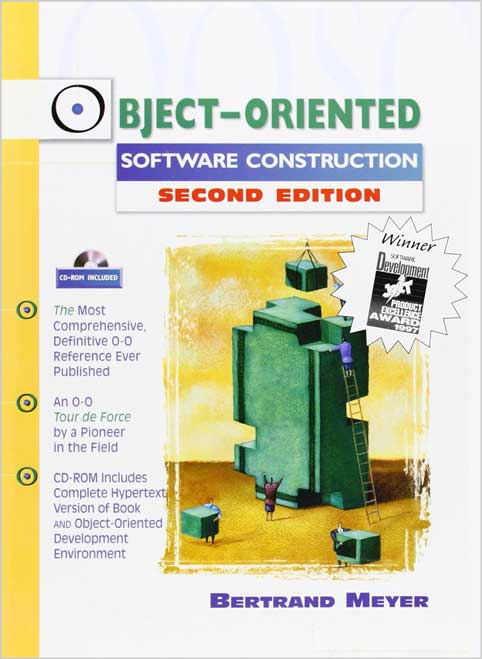
#Object-Oriented
#Software
The developer of the acclaimed Eiffel programming language comes through with one of the clearest and most informative books about computers ever committed to paper. Object-Oriented Software Construction is the gospel of object-oriented technology and it deserves to be spread everywhere. Meyer opens with coverage of the need for an object-oriented approach to software development, citing improved quality and development speed as key advantages of the approach.
He then explains all the key criteria that define an object-oriented approach to a problem. Meyer pays attention to techniques, such as classes, objects, memory management, and more, returning to each technique and polishing his readers' knowledge of it as he explains how to employ it "well". In a section on advanced topics, Meyer explores interesting and relevant topics, such as persistent objects stored in a database. He also offers a sort of "Do and Don't" section in which he enumerates common mistakes and ways to avoid them.
Management information isn't the main point of Object-Oriented Software Construction, but you'll find some in its pages. Meyer concludes his tour de force with comparisons of all the key object-oriented languages, including Java. He also covers the potential of simulating object technology in non-object-oriented languages, such as Pascal and Fortran. The companion CD-ROM includes the full text of this book in hypertext form, as well as some tools for designing object-oriented systems. If you program computers, you need to read this book. --Jake Bond
The definitive reference on the most important new technology in software!
“While the original version of OOSC is a classic, OOSC 2/E is destined to overshadow it and all other general introductions . . . literally an epic work.”
―James C. McKim, Jr., Hartford Graduate Center
“Compelling. Extremely well-written and literate . . . I recaptured that same sense of intellectual excitement I felt reading the first edition for the first time.”
―Paul Dubois, Lawrence Livermore National Laboratory, Editor, Scientific Programming Dept., Computers in Physics
“The definitive tome on Object-Orientation . . . the finest piece of writing and thinking about this vast subject . . . Bertrand has a lot to say of great importance and says it well in this significantly revised book.”
―Richard Wiener, University of Colorado, Colorado Springs, Editor, Journal for Object-Oriented Programming
A whole generation was introduced to object technology through the first edition of Bertrand Meyer's OOSC. This long-awaited new edition retains the qualities of clarity, practicality and scholarship that made the first an instant best-seller. It has been thoroughly revised and considerably expanded. No other book on the market provides such a breadth and depth of coverage on the most important technology in software development.
SOME OF THE NEW TOPICS COVERED IN DEPTH BY THIS SECOND EDITION:
Table of Contents
PART A: THE ISSUES
Chapter 1: Software quality
Chapter 2: Criteria of object orientation
PART B: THE ROAD TO OBJECT ORIENTATION
Chapter 3: Modularity
Chapter 4: Approaches to reusability
Chapter 5: Towards object technology
Chapter 6: Abstract data types
PART C: OBJECT-ORIENTED TECHNIQUES
Chapter 7: The static structure: classes
Chapter 8: The run-time structure: objects
Chapter 9: Memory management
Chapter 10: Genericity
Chapter 11: Design by Contract: building reliable software
Chapter 12: When the contract is broken: exception handling
Chapter 13: Supporting mechanisms
Chapter 14: Introduction to inheritance
Chapter 15: Multiple inheritance
Chapter 16: Inheritance techniques
Chapter 17: Typing
Chapter 18: Global objects and constants
PART D: OBJECT-ORIENTED METHODOLOGY: APPLYING THE METHOD WELL
Chapter 19: On methodology
Chapter 20: Design pattern: multi-panel interactive systems
Chapter 21: Inheritance case study: “undo” in an interactive system
Chapter 22: How to find the classes
Chapter 23: Principles of class design
Chapter 24: Using inheritance well
Chapter 25: Useful techniques
Chapter 26: A sense of style
Chapter 27: Object-oriented analysis
Chapter 28: The software construction process
Chapter 29: Teaching the method
PART E: ADVANCED TOPICS
Chapter 30: Concurrency, distribution, client-server and the Internet
Chapter 31: Object persistence and databases
Chapter 32: Some O-O techniques for graphical interactive applications
PART F: APPLYING THE METHOD IN VARIOUS LANGUAGES AND ENVIRONMENTS
Chapter 33: O-O programming and Ada
Chapter 34: Emulating object technology in non-O-O environments
Chapter 35: Simula to Java and beyond: major O-O languages and environments
PART G: DOING IT RIGHT
Chapter 36: An object-oriented environment
PART H: APPENDICES
Appendix A: Extracts from the Base libraries
Appendix B: Genericity versus inheritance
Appendix C: Principles, rules, precepts and definitions
Appendix D: A glossary of object technology
BERTRAND MEYER is one of the pioneers of modern software engineering, whose experience spans both industry and academia. He has led the development of successful O-O products and libraries totaling thousands of classes. His Prentice Hall books include Object Success (an introduction to object technology for managers), Introduction to the Theory of Programming Languages, Eiffel: The Language, Object-Oriented Applications, and Reusable Software. He is a frequent keynote speaker at international conferences and consultant for Fortune 500 companies, editor of the Object-Oriented Series, associate member of the applications section of the French Academy of Sciences, chairman of the TOOLS conference series, and editor of the Object Technology department of IEEE Computer.