ثبت نام / ورود
0
ثبت نام / ورود
0
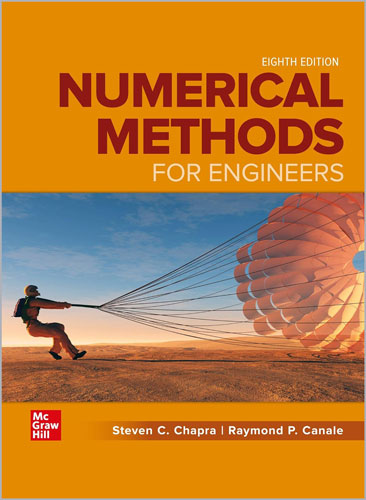
Steven C. Chapra, Raymond P. Canale
#Numerical
#Engineers
#Partial_differential_equations
The eighth edition of Chapra and Canale's Numerical Methods for Engineers retains the instructional techniques that have made the text so successful. The book covers the standard numerical methods employed by both students and practicing engineers. Although relevant theory is covered, the primary emphasis is on how the methods are applied for engineering problem solving. Each part of the book includes a chapter devoted to case studies from the major engineering disciplines. Numerous new or revised end-of chapter problems and case studies are drawn from actual engineering practice. This edition also includes several new topics including a new formulation for cubic splines, Monte Carlo integration, and supplementary material on hyperbolic partial differential equations.
Table of Contents
Chapter 1 Mathematical Modeling and Engineering Problem Solving
Chapter 2 Programing and Software
Chapter 3 Approximations and Round-Off Errors
Chapter 4 Truncation Errors and the Taylor Series
Epilogue: Part One
Epilogue: Cont. Roots of Equations
Chapter 5 Bracketing Methods
Chapter 6 Open Methods
Chapter 7 Roots of Polynomials
Chapter 8 Case Studies: Roots of Equations
Epilogue: Part Two
Epilogue: Cont. Linear Algebraic Equations
Chapter 9 Gauss Elimination
Chapter 10 LU Decomposition and Matrix Inversion
Chapter 11 Special Matricies and Gauss-Seidel
Chapter 12 Case Studies: Linear Algebraic Equations
Epilogue: Part Three
Epilogue: Cont. Optimization
Chapter 13 One-Dimensional Unconstrained Optimization
Chapter 14 Multidimensional Unconstrained Optimization
Chapter 15 Constrained Optimization
Chapter 16 Case Studies: Optimization
Epilogue: Part Four
Epilogue: Cont. Curve Fitting
Chapter 17 Least-Squares Regression
Chapter 18 Interpolation
Chapter 19 Fourier Approximation
Chapter 20 Case Studies: Curve Fitting
Epilogue: Part Five
Epilogue: Cont. Numerical Differentiation and Integration
Chapter 21 Newton-Cotes Integration Formulas
Chapter 22 Integration of Equations
Chapter 23 Numerical Differentiation
Chapter 24 Case Studies: Numerical Integration and Differentiation
Epilogue: Part Six
Epilogue: Cont. Ordinary Differential Equations
Chapter 25 Runge-Kutta Methods
Chapter 26 Stiffness and Multistep Methods
Chapter 27 Boundary-Value and Eigenvalue Problems
Chapter 28 Case Studies: Ordinary Differential Equations
Epilogue: Part Seven
Epilogue: Cont. Partial Differential Equations
Chapter 29 Finite Difference: Elliptic Equations
Chapter 30 Finite Difference: Parabolic Equations
Chapter 31 Finite-Element Method
Chapter 32 Case Studies: Partial Eifferential Equations
Epilogue: Part Eight
Appendix A
Appendix B
Appendix C
Steve Chapra is the Emeritus Professor and Emeritus Berger Chair in the Civil and Environmental Engineering Department at Tufts University. His other books include Surface Water-Quality Modeling, Numerical Methods for Engineers, and Applied Numerical Methods with Python.
Dr. Chapra received engineering degrees from Manhattan College and the University of Michigan. Before joining Tufts, he worked for the U.S. Environmental Protection Agency and the National Oceanic and Atmospheric Administration, and taught at Texas A&M University, the University of Colorado, and Imperial College London. His general research interests focus on surface water-quality modeling and advanced computer applications in environmental engineering.
He is a Fellow and Life Member of the American Society of Civil Engineering (ASCE) and has received many awards for his scholarly and academic contributions, including the Rudolph Hering Medal (ASCE) for his research, and the Meriam-Wiley Distinguished Author Award (American Society for Engineering Education). He has also been recognized as an outstanding teacher and advisor among the engineering faculties at Texas A&M University, the University of Colorado, and Tufts University. As a strong proponent of continuing education, he has also taught over 90 workshops for professionals on numerical methods, computer programming, and environmental modeling.