ثبت نام / ورود
0
ثبت نام / ورود
0
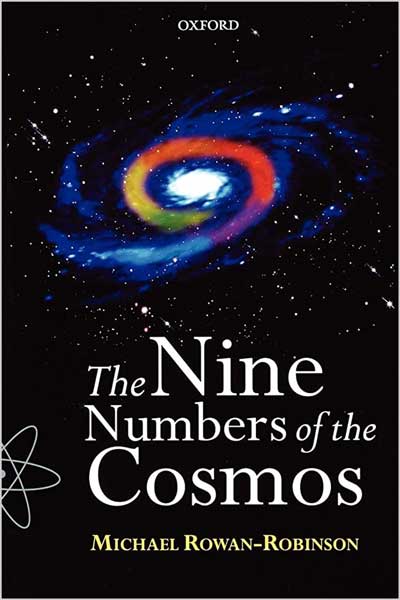
Michael Rowan-Robinson
#Cosmos
#universe
#dark_matter
#quantum_theory
How old is the universe? How far away are the galaxies and how fast are they travelling away from us? What is dark matter and why do astronomers think it pervades the universe? How heavy is the vacuum? How do galaxies form?
Michael Rowan-Robinson answers these and many more questions in a highly original and intriguing way. He encapsulates our current knowledge (both what we do and don't know) of the origin and the nature of the universe into nine numbers.
These cosmic numbers appear to be independent characteristics of our universe and include its age, the Hubble constant (a measure of its rate of expression), and the density of matter in the universe.
Only one of the nine numbers is known with real precision, and four of them only poorly known. The complex ideas that underpin modern cosmology such as the origin of the elements and quantum theory are explained clearly and accessibly, and more speculative ideas like inflation and superstrings are also covered, but with a refreshing scepticism.
While most
of what we know has been learnt during the 20th century, Rowan-Robinson provides a historical perspective, paying homage to the achievements of the Greeks, Renaissance astronomers, and the age of Newton. He ends the book with a look to the future, predicting that with the further space missions we will accurately know the nine numbers described in this book by the year 2015, but concludes that the origin of the Big Bang itself will still be a mystery by the end of the twenty-first century, and
perhaps even in the year 3000.
The science of cosmology asks the big questions: How old and how large is the universe? How did it start? How did stars and galaxies come into being? What will the future bring? As such, it is a mixture of astronomy, physics, and philosophy with religious implications.
Since no one can go backward or forward in time and actually observe the process, there is a lot of room for debate.
However, a general consensus is emerging among scientists based upon the best available evidence. Physics professor Rowan-Robinson describes our state-of-the-art answers to these questions. More importantly, he indicates the direction in which further research is heading in an attempt to pin down the important parameters (the nine numbers) that will resolve most of the open questions. Although not easy going, this book is recommended to informed lay readers who have been following recent developments and would like to know where we stand. For larger science collections.
-Harold D. Shane, Baruch Coll., CUNY
Drawing upon Descartes's saying, "What do I know?" Rowan-Robinson asks what we know about the universe. In answer, he has come up with nine numbers that summarize our current understanding of the cosmos. The practice of using numerology and mystical numbers to understand reality dates back through the astrologers and alchemists to antiquity, but the numbers Rowan-Robinson presents are grounded in scientific research, although more than a little speculation was used in deriving a couple of them.
Rowan-Robinson, a physics professor at Imperial College, London, and author of two other books on cosmology (Ripples in the Cosmos; Cosmology), wants to keep readers in suspense and so unveils his numbers chapter by chapter, instead of summarizing them at the beginning, which would give readers a better overview and help them to see how each number relates to the others instead of having to wait until the conclusion. His nine numbers relate to the density of baryonic matter, the anisotropy of the universe, the Hubble constant, the age of the universe, the temperature of the microwave background, the densities of cold dark matter and hot dark matter, the cosmological constant and the star formation history of the universe.
Rowan-Robinson's writing is a bit dry and some of his explanations are too condensed, but readers should gain an excellent understanding of what we currently know about the universe and the techniques through which we have acquired that knowledge. Much of this may not be new to dedicated science buffs, but the book is a good summary and will make a useful addition to general science collections. (Dec.)