ثبت نام / ورود
0
ثبت نام / ورود
0
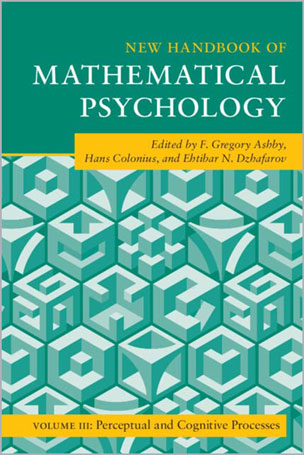
Volume 3, Perceptual and Cognitive Processes
William H. Batchelder, Hans Colonius, Ehtibar N. Dzhafarov
#Mathematical
#Psychology
#Methodology
#Network
#Bayesian_Computation
The field of mathematical psychology began in the 1950s and includes both psychological theorizing, in which mathematics plays a key role, and applied mathematics motivated by substantive problems in psychology. Central to its success was the publication of the first Handbook of Mathematical Psychology in the 1960s. The psychological sciences have since expanded to include new areas of research, and significant advances have been made both in traditional psychological domains and in the applications of the computational sciences to psychology. Upholding the rigor of the original Handbook, the New Handbook of Mathematical Psychology reflects the current state of the field by exploring the mathematical and computational foundations of new developments over the last half-century. The third volume provides up-to-date, foundational chapters on early vision, psychophysics and scaling, multisensory integration, learning and memory, cognitive control, approximate Bayesian computation, and encoding models in neuroimaging.
Table of Contents
1 Principles and Consequences of the Initial Visual Encoding
2 Measuring Multisensory Integration in Selected Paradigms
3 Fechnerian Scaling: Dissimilarity Cumulation Theory
4 Mathematical Models of Human Learning
5 Formal Models of Memory Based on Temporally-Varying Representations
6 Statistical Decision Theory
7 Modeling Response Inhibition in the Stop-Signal Task
8 Approximate Bayesian Computation
9 Cognitive Diagnosis Models
10 Encoding Models in Neuroimaging
About the Authors
William H. Batchelder is Professor of Cognitive Sciences at the University of California, Irvine.
Hans Colonius is Professor of Psychology at Carl V. Ossietzky Universität Oldenburg, Germany.
Ehtibar N. Dzhafarov is Professor of Psychological Sciences at Purdue University, Indiana.