ثبت نام / ورود
0
ثبت نام / ورود
0
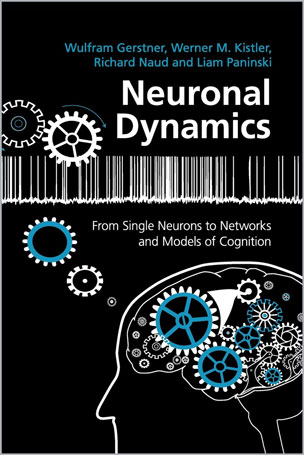
From Single Neurons to Networks and Models of Cognition
Wulfram Gerstner, Werner M. Kistler, Richard Naud, Liam Paninski
#Neuronal
#Cognition
#Neuroscience
#Brain
What happens in our brain when we make a decision? What triggers a neuron to send out a signal? What is the neural code? This textbook for advanced undergraduate and beginning graduate students provides a thorough and up-to-date introduction to the fields of computational and theoretical neuroscience. It covers classical topics, including the Hodgkin–Huxley equations and Hopfield model, as well as modern developments in the field such as generalized linear models and decision theory. Concepts are introduced using clear step-by-step explanations suitable for readers with only a basic knowledge of differential equations and probabilities, and are richly illustrated by figures and worked-out examples. End-of-chapter summaries and classroom-tested exercises make the book ideal for courses or for self-study. The authors also give pointers to the literature and an extensive bibliography, which will prove invaluable to readers interested in further study.
Table of Contents
PART ONE FOUNDATIONS OF NEURONAL DYNAMICS
1 Introduction: neurons and mathematics
2 Ion channels and the Hodgkin–Huxley model
3 Dendrites and synapses
4 Dimensionality reduction and phase plane analysis
PART TWO GENERALIZED INTEGRATE-AND-FIRE NEURONS
5 Nonlinear integrate-and-fire models
6 Adaptation and firing patterns
7 Variability of spike trains and neural codes
8 Noisy input models: barrage of spike arrivals
9 Noisy output: escape rate and soft threshold
10 Estimating parameters of probabilistic neuron models
11 Encoding and decoding with stochastic neuron models
PART THREE NETWORKS OF NEURONS AND POPULATION ACTIVITY
12 Neuronal populations
13 Continuity equation and the Fokker–Planck approach
14 Quasi-renewal theory and the integral-equation approach
15 Fast transients and rate models
PART FOUR DYNAMICS OF COGNITION
17 Memory and attractor dynamics
18 Cortical field models for perception
19 Synaptic plasticity and learning
20 Outlook: dynamics in plastic networks
About the Authors
Wulfram Gerstner is Director of the Laboratory of Computational Neuroscience and a Professor of Life Sciences and Computer Science at the École Polytechnique Fédérale de Lausanne (EPFL) in Switzerland. He studied physics in Tubingen and Munich and holds a PhD from the Technical University of Munich. His research in computational neuroscience concentrates on models of spiking neurons and synaptic plasticity. He teaches computational neuroscience to physicists, computer scientists, mathematicians, and life scientists. He is a co-author of Spiking Neuron Models (Cambridge, 2002).
Werner M. Kistler received a Master's and PhD in physics from the Technical University of Munich. He previously worked as Assistant Professor in Rotterdam for computational neuroscience and he is the co-author of Spiking Neuron Models (Cambridge, 2002). He is now working in Munich as a patent attorney. His scientific contributions are related to spiking neuron models, synaptic plasticity, and network models of the cerebellum and the inferior olive.
Richard Naud holds a PhD in computational neuroscience from the EPFL in Switzerland and a Bachelor's degree in physics from McGill University, Canada. He has published several scientific articles and book chapters on the dynamics of neurons. He is now a postdoctoral researcher.
Liam Paninski is a Professor in the Department of Statistics at Columbia University and co-director of the Grossman Center for the Statistics of Mind. He is also a member of the Center for Theoretical Neuroscience, the Kavli Institute for Brain Science and the doctoral program in neurobiology and behavior. He holds a PhD in neuroscience from New York University and a Bachelor's from Brown University. His work focuses on neuron models, estimation methods, neural coding and neural decoding. He teaches courses on computational statistics, inference, and statistical analysis of neural data.