ثبت نام / ورود
0
ثبت نام / ورود
0
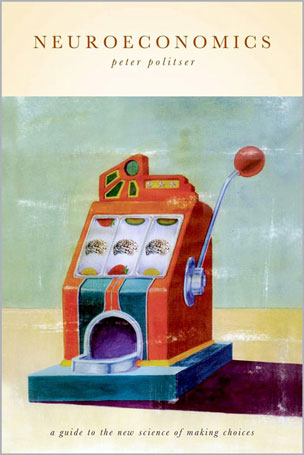
A Guide to the New Science of Making Choices
Peter Politser
#Neuroeconomics
#Choices
#Money
As technology has opened new windows into the brain, it has clarified what happens there when people make decisions about money. This clarity has produced a new science called neuroeconomics, which addresses diverse questions, such as why people save, buy stocks, steal, and overspend. The many different methods used in neuroeconomics have, however, often yielded unclear findings about the quality of these decisions, primarily because the field has lacked both guidelines for categorizing the different aspects of quality, and guidelines for selecting methods to study these aspects. Before this book, in which Peter Politser guides the reader through the different regions of study, there was no scientific guide for those interested in neuroeconomics. Politser shows how to evaluate specific elements of choice, such as regret, expectation, risk, ambiguity, time preference, and learning, and surveys economic and behavioral models of decision making skills. He reviews the neural correlates of decisional impairments and inconsistenciesclarifying, for example, why we do not recall what we experience, experience what we expect, or like what we want, and provides detailed tables of decision-making skills, their neural correlates, and possible impairments. Politser also considers what the field of neuroeconomics may add to future conceptions of decision making, and outlines the limitations of various studies of different capacities. He then introduces a broader field for the design and interpretation of neuroeconomic studiesa neuroepidemiology of decision making. Everyone who wants to understand the research in neuroeconomics or use its methods should read this book. Its accessible text, along with an extensive glossary, will guide those with little economic or neuroscience background, and make the book an excellent supplement for courses on neuroscience and decision making.
Table of Contents
1: Introduction: Toward a Biological Science of Making Choices
2: What Are the Components of Choice?
3: Th e Efficacy of Evaluation: What Are the Economic Elements of the Ability to Evaluate Risk and Reward?
4: Th e Effectiveness of Evaluation: What Other Psychological Abilities Affect Evaluation?
5: Conclusion: Future Directions for the New Science
"Peter Politser has provided a valuable and readable introduction to the burgeoning field of neuroeconomics that successfully brings together the essential concepts from psychology, neuroscience and economics."--T.W. Robbins, Professor of Cognitive Neuroscience, University of Cambridge
"...provides a valuable review of a large, complex body of research. Two summary tables, organized by theory, help the reader to evaluate this information, so we can begin to recognize neurological correlates of the theoretical constructs. For a psychologist who is interested in contributions that neuroscience can make the study of decision making, the book contains a great deal of valuable information."--PsycCritiques
"Given its brevity, breadth of coverage, and complexity, the book is best suited as a study guide for researchers in adjacent fields...Helpful glossary and list of primary citations. Recommended."--Choice
"Dr. Politser does an excellent job of integrating neurobiology and economics in 140 pages (glossary, references, and appendices excluded) . . . Particular strengths of the text are Dr. Politser's apparent grasp and understanding of complex neuroeconomics principles, and his writing style. . . From this reviewer's perspective, Dr. Politser's approach reflects the fact that he has considered the ecological validity of these economic principles--in other words, the degree to which they can be applied to day-to-day functioning. Moreover, and equally important, he makes a conscious effort to liven up the material, which is quite dense and might otherwise be less entertaining, and engages readers so that they might use this line of reasoning to generate their own examples of how these theories might explain human decision-making."----Ari Kalechstein in Journal of Gambling Issues
Peter Politser is in the Department of Family Medicine, Brown University.