ثبت نام / ورود
0
ثبت نام / ورود
0
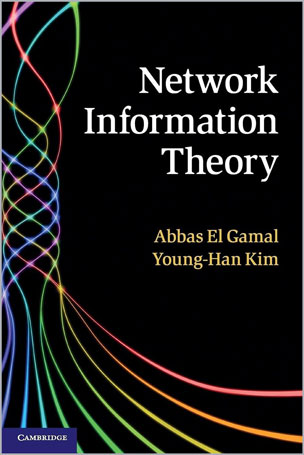
Abbas El Gamal, Young-Han Kim
#Network
#Information_Theory
#Gaussian
#SINGLE-HOP
This comprehensive treatment of network information theory and its applications provides the first unified coverage of both classical and recent results. With an approach that balances the introduction of new models and new coding techniques, readers are guided through Shannon’s point-to-point information theory, single-hop networks, multihop networks, and extensions to distributed computing, secrecy, wireless communication, and networking. Elementary mathematical tools and techniques are used throughout, requiring only basic knowledge of probability, whilst unified proofs of coding theorems are based on a few simple lemmas, making the text accessible to newcomers. Key topics covered include successive cancellation and superposition coding, MIMO wireless communication, network coding, and cooperative relaying. Also covered are feedback and interactive communication, capacity approximations and scaling laws, and asynchronous and random access channels. This book is ideal for use in the classroom, for self-study, and as a reference for researchers and engineers in industry and academia.
Table of Contents
CHAPTER 1
PART I PRELIMINARIES
CHAPTER 2 Information Measures and Typicality
CHAPTER 3 Point-to -Point Information Theory
PART II SINGLE-HOP NETWORKS
CHAPTER 4 Multiple Access Channels
CHAPTER 5 Degraded Broadcast Channels
CHAPTER 6 Interference Channels
CHAPTER 7 Channels with State
CHAPTER 8 General Broadcast Channels
CHAPTER 9 Gaussian Vector Channels
CHAPTER 10 Distributed Lossless Compression
CHAPTER 11 Lossy Compression with Side Information
CHAPTER 12 Distributed Lossy Compression
CHAPTER 13 Multiple Description Coding
CHAPTER 14 Joint Source- Channel Coding
PART Ill MULTI HOP NETWORKS
CHAPTER 15 Graphical Networks
CHAPTER 16 Relay Channels
CHAPTER 17 Interactive Channel Coding
CHAPTER 18 Discrete Memoryless Networks
CHAPTER 19 Gaussian Networks
CHAPTER 20 Compression over Graphical Networks
PART IV EXTENSIONS
CHAPTER 21 Communication for Computing
CHAPTER 22 Information Theoretic Secrecy
CHAPTER 23 Wireless Fading Channels
CHAPTER 24 Networking and Information Theory
Abbas El Gamal is the Hitachi America Chaired Professor in the School of Engineering and the Chair of the Department of Electrical Engineering at Stanford University, California. In the field of network information theory, he is best known for his seminal contributions to the relay, broadcast, and interference channels; multiple description coding; coding for noisy networks; and energy-efficient packet scheduling and throughput-delay tradeoffs in wireless networks. He is a Fellow of the Institute of Electrical and Electronics Engineers and the winner of the 2012 Claude E. Shannon Award, the highest honor in the field of information theory.
Young-Han Kim is an Associate Professor in the Department of Electrical and Computer Engineering at the University of California, San Diego. His research focuses on information theory and statistical signal processing. He is a recipient of the 2012 Institute of Electrical and Electronics Engineers Information Theory Paper Award and the 2008 National Science Foundation Faculty Early Career Development (CAREER) Award.