ثبت نام / ورود
0
ثبت نام / ورود
0
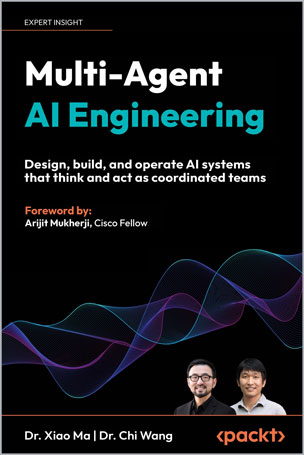
Design, build, and operate AI systems that think and act ascoordinated teams
Xiao Ma, Chi Wang
#Multi-Agent
#AI
#Engineering
#OpenTelemetry
Move agentic AI from clever demos to reliable production with the principles, patterns, and practices behind multi-agent systems at scale.
As AI systems take on more complex tasks, the limits of single-model applications become increasingly clear. Problems requiring long-horizon reasoning, specialized expertise, coordination, and parallel execution demand multiple agents working together reliably in production.
But building multi-agent systems is fundamentally an engineering challenge. Agents must communicate, delegate tasks, manage context, recover from failures, and stay aligned on shared goals under real-world constraints.
Multi-Agent AI Engineering is a practical guide to designing and operating production-grade multi-agent systems. Drawing on the authors’ research, open-source contributions, and experience building AI systems at scale, the book focuses on architectural principles that extend beyond any single framework or trend.
You’ll explore agent foundations, communication protocols, memory and context management, orchestration, interoperability standards, and canonical multi-agent patterns through hands-on Python examples. The book also covers production realities including evaluation, observability, reliability, safe self-improvement, and scaling agentic systems in practice.
By the end, you’ll be equipped to design, build, and scale reliable multi-agent systems for real-world deployment.
If you are an AI engineer, ML practitioner, software architect, or technical leader who wants to move beyond agent demos and ship multi-agent AI systems that work in production, this book is for you. By the end, you will be able to design, deploy, evaluate, and continuously improve agentic systems with confidence. It is equally valuable for engineering and product managers making informed decisions about agentic AI architecture. Readers should be comfortable with Python and have basic familiarity with LLMs; deep ML expertise is not required.
Part 1: Foundations
Chapter 1: Introduction to Multi-Agent Systems
Chapter 2: Principles of Multi-Agent Systems
Chapter 3: Frameworks and Mental Models
Chapter 4: Constructing Your First Agents
Part 2: Building Multi-Agent Systems
Chapter 5: Agent Communication
Chapter 6: Design Patterns for Multi-Agent Collaboration
Chapter 7: Context and Memory Management
Chapter 8: Orchestrating Agent Teams
Chapter 9: Unified Abstractions and Protocols for Agent Collaboration
Chapter 10: Comparative Survey of Frameworks
Part 3: Evaluating, Observing, Evolving, and Securing Multi-Agent Systems
Chapter 11: Evaluating the Performance and Behaviors of Multi-Agent Systems
Chapter 12: Observability for Agentic AI
Chapter 13: Self-Evolving Multi-Agent Systems
Chapter 14: Security and Privacy for Multi-Agent Systems
Chapter 15: Deploying and Scaling Multi-Agent Systems
Part 4: Practice and Outlook
Chapter 16: Case Studies from Real-World Applications
Chapter 17: Emerging Research and Industry Trends
Chapter 18: Conclusions and Future Outlook
Xiao Ma is an engineering executive with 15+ years of experience in ML/AI systems across academia and industry. He holds a Ph.D. in Computer Science from the University of Illinois, specialized in the intersection of machine learning and computer systems. As Chief Architect at Pattern Insight and Medium, he led teams developing large-scale ML systems for both enterprise and consumer markets. Currently at Splunk, a Cisco Company, he leads teams building Splunk Observability Cloud, a full-stack solution (connecting infrastructure, applications, and business impact) featuring enterprise-class multi-agent AI systems and industry-leading AI Observability products that empower customers to innovate with confidence at scale.
Chi Wang is the creator of AutoGen, AG2, MassGen, Sutando — open-source projects for agentic AI used by Nvidia, Google, Microsoft, and leading research institutions worldwide. He previously led agentic AI work as a Senior Staff Research Scientist at Google DeepMind, pioneered agentic AI research at Microsoft Research, and created FLAML for AutoML. He teaches at Stanford, Berkeley, Coursera, and DeepLearning[Dot]AI. His work has earned the UIUC Siebel School Early Career Alumni Achievement Award, Best Paper at the ICLR'24 LLM Agents Workshop, and the SIGKDD PhD Dissertation Award.