ثبت نام / ورود
0
ثبت نام / ورود
0
Andrew Tanenbaum, Herbert Bos
#Operating_Systems
#Computer_Science
#Computer_Engineering
#Electrical_Engineering
#Unix
#Linux
#Android
#Cloud
#System_Design
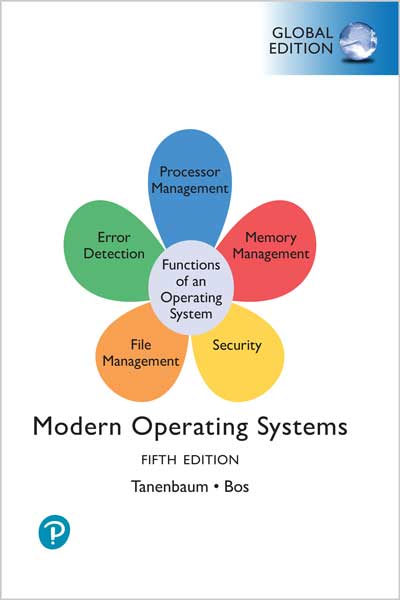
Modern Operating Systems incorporates the latest developments and technologies in operating systems (OS) technologies. Author Andy Tanenbaum's clear and entertaining writing style outlines the concepts every OS designer needs to master. In-depth topic coverage includes processes, threads, memory management, file systems, I/O, deadlocks, interface design, multimedia, performance tradeoffs, and trends in OS design. Case studies explore popular OS and provide real-world context. Tanenbaum also provides information on current research based on his experience as an operating systems researcher.
The 5th Edition of this book differs from the fourth edition in many ways. There are large numbers of small changes everywhere to bring the material up to date as operating systems are not standing still. For example, where the previous edition focused almost exclusively on magnetic hard disks for storage, this time we give the flash-based Solid State Drives (SSDs) the attention that befits their popularity. The chapter on Windows 8.1 has been replaced entirely by a chapter on the new Windows 11. We hav e rewritten much of the security chapter, with more focus on topics that are directly relevant for operating systems (and exciting new attacks and defenses), while reducing the discussion of cryptography and steganography. Here is a chapter-by-chapter rundown of the changes.
Contents
1. Introduction
2. Processes and Threads
3. Memory Management
4. File Systems
5. Input/Output
6. Deadlocks
7. Virtualization and the Cloud
8. Multiple Processor Systems
9. Security
10. Case Study 1: Unix, Linux, and Android
11. Case Study 2: Windows 11
12. Operating System Design
13. Reading List and Bibliography
• Chapter 1 has been heavily modified and updated in many places, but with the exception of dropping the description of CD-ROMs and DVDs in favor of modern storage solutions such as SSDs and persistent memory, no major sections have been added or deleted.
• In Chapter 2, we significantly expanded the discussion of event-driven servers and included an extensive example with pseudo code. We gav e priority inversion its own section where we also discussed ways to deal with the problem. We reordered some of the sections to clarify the discussion. For instance, we now discuss the readers-writers problem immediately after the producer-consumer section and moved the dining philosophers to another chapter, that of deadlocks, entirely. Besides numerous smaller updates, we also dropped some older material, such as scheduler activations and pop-up threads.
• Chapter 3 now focuses on modern 64-bit architectures and contains more precise explanations of many aspects of paging and TLBs. For instance, we describe how operating systems use paging also and how some operating systems map the kernel into the address spaces of user processes.
• Chapter 4 changed significantly.Wedropped the lengthydescriptions of CD-ROMs and tapes, and instead added sections about SSD-based file systems, booting in modern UEFI-based computer systems, and secure file deletion and disk encryption.
• In Chapter 5, we have more information about SSDs and NVMe, and explain input devices using a modern USB keyboard instead of the older PS/2 one of the previous edition. In addition, we clarify the relation between interrupts, traps, exceptions, and faults.
• As mentioned, we added the dining philosophers example to Chapter 6. Other than that, the chapter is pretty much unchanged. The topic of deadlocks is fairly stable, with few new results.
• In Chapter 7, we added a section about containers to the existing (and updated) explanation of hypervisor-based virtualization. The material on VMware has also been brought up to date.
• Chapter 8 is an updated version of the previous material on multiprocessor systems. We added subsections on simultaneous multithreading and discuss new types of coprocessors, while dropping sections such as the one on the older IXP network processors and the one on the (now dead) CORBA middleware. A new section discusses scheduling for security.
• Chapter 9 has been heavily revised and reorganized, with much more focus on what is relevant for the operating system and less emphasis on crypto. We now start the chapter with a discussion of principles for secure design and their relevance for the operating system structure. We discuss exciting new hardware developments, such as the Meltdown and Spectre transient execution vulnerabilities, that have come to light since the previous edition. In addition, we describe new software vulnerabilities that are important for the operating system. Finally, we greatly expanded the description of the ways in which the operating system can be hardened, with extensive discussion of control flow integrity, fine-grained ASLR, code signing, access restrictions, and attestation. Since there is much ongoing research in this area, new references have been added and the research section has been rewritten.
• Chapter 10 has been updated with new dev elopments in Linux and Android. Android has evolved considerably since the previous edition, and this chapter covers the current version in detail. This section has been substantially rewritten.
• Chapter 11 has changed significantly. Where the fourth edition was on Windows 8.1, we now discuss Windows 11. It is basically a new chapter.
• Chapter 12 is a slightly revised version of the previous edition. This chapter covers the basic principles of system design, and they hav e not changed much in the past few years.
• Chapter 13 is a thoroughly updated list of suggested readings. In addition, the list of references has been updated, with entries to well over 100 new works published after the fourth edition of this book came out.
• In addition, the sections on research throughout the book have all been redone from scratch to reflect the latest research in operating systems. Furthermore, new problems have been added to all the chapters.
Andrew S. Tanenbaum has an S.B. degree from M.I.T. and a Ph.D. from the University of California at Berkeley. He is currently a Professor Emeritus of Computer Science at the Vrije Universiteit in Amsterdam, The Netherlands. He was formerly Dean of the Advanced School for Computing and Imaging, an interuniversity graduate school doing research on advanced parallel, distributed, and imaging systems. He was also an Academy Professor of the Royal Netherlands Academy of Arts and Sciences, which has saved him from turning into a bureaucrat. He also won a prestigious European Research Council Advanced Grant.
Herbert Bos obtained his Master’s degree from Twente University and his Ph.D. from Cambridge University in the United Kingdom. Since then, he has worked extensively on dependable and efficient I/O architectures for operating systems like Linux, but also research systems based on MINIX 3. He is currently a professor at the VUSec Systems Security Research Group in the Department. of Computer Science at the Vrije Universiteit in Amsterdam, The Netherlands. His main research field is systems security.