ثبت نام / ورود
0
ثبت نام / ورود
0
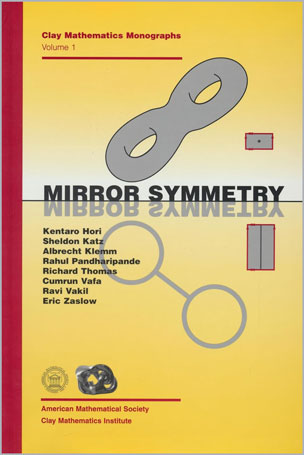
Kentaro Hori, Sheldon Katz, Albrecht Klemm, Rahul Pandharipande, Richard Thomas, Cumrun Vafa, Ravi Vakil, Eric Zaslow
#Mirror_Symmetry
#Differential_Geometry
#Physics_Proof
#Algebraic_Geometry
#Topology
#Physics
#_Proof
#Mathematics_Proof
#Strings
#Quantum_Mechanics
This thorough and detailed exposition is the result of an intensive month-long course sponsored by the Clay Mathematics Institute. It develops mirror symmetry from both mathematical and physical perspectives. The material will be particularly useful for those wishing to advance their understanding by exploring mirror symmetry at the interface of mathematics and physics.
This one-of-a-kind volume offers the first comprehensive exposition on this increasingly active area of study. It is carefully written by leading experts who explain the main concepts without assuming too much prerequisite knowledge. The book is an excellent resource for graduate students and research mathematicians interested in mathematical and theoretical physics.
Part 1. Mathematical Preliminaries
Chapter 1. Differential Geometry
Chapter 2. Algebraic Geometry
Chapter 3. Differential and Algebraic Topology
Chapter 4. Equivariant Cohomology and Fixed-Point Theorems
Chapter 5. Complex and K¨ahler Geometry
Chapter 6. Calabi–Yau Manifolds and Their Moduli
Chapter 7. Toric Geometry for String Theory
Part 2. Physics Preliminaries
Chapter 8. What Is a QFT?
Chapter 9. QFT in d = 0
Chapter 10. QFT in Dimension 1: Quantum Mechanics
Chapter 11. Free Quantum Field Theories in 1 + 1 Dimensions
Chapter 12. N = (2, 2) Supersymmetry
Chapter 13. Non-linear Sigma Models and Landau–Ginzburg Models
Chapter 14. Renormalization Group Flow
Chapter 15. Linear Sigma Models
Chapter 16. Chiral Rings and Topological Field Theory
Chapter 17. Chiral Rings and the Geometry of the Vacuum Bundle
Chapter 18. BPS Solitons in N=2 Landau–Ginzburg Theories
Chapter 19. D-branes
Part 3. Mirror Symmetry: Physics Proof
Chapter 20. Proof of Mirror Symmetry
Part 4. Mirror Symmetry: Mathematics Proof
Chapter 21. Introduction and Overview
Chapter 22. Complex Curves (Non-singular and Nodal)
Chapter 23. Moduli Spaces of Curves
Chapter 24. Moduli Spaces Mg,n(X, β) of Stable Maps
Chapter 25. Cohomology Classes on Mg,n and Mg,n(X, β)
Chapter 26. The Virtual Fundamental Class, Gromov–Witten Invariants, and Descendant Invariants
Chapter 27. Localization on the Moduli Space of Maps
Chapter 28. The Fundamental Solution of the Quantum Differential Equation
Chapter 29. The Mirror Conjecture for Hypersurfaces I: The Fano Case
Chapter 30. The Mirror Conjecture for Hypersurfaces II: The Calabi–Yau Case
Part 5. Advanced Topics
Chapter 31. Topological Strings
Chapter 32. Topological Strings and Target Space Physics
Chapter 33. Mathematical Formulation of Gopakumar–Vafa Invariants
Chapter 34. Multiple Covers, Integrality, and Gopakumar–Vafa Invariants
Chapter 35. Mirror Symmetry at Higher Genus
Chapter 36. Some Applications of Mirror Symmetry
Chapter 37. Aspects of Mirror Symmetry and D-branes
Chapter 38. More on the Mathematics of D-branes: Bundles, Derived Categories, and Lagrangians
Chapter 39. Boundary N = 2 Theories
Chapter 40. References
"This book, a product of the collective efforts of the lecturers at the School organized ... by the Clay Mathematics Institute, is a valuable contribution to the continuing intensive collaboration of physicists and mathematicians. It will be of great value to young and mature researchers in both communities interested in this fascinating modern grand unification project." ---- Yuri Manin, Max Planck Institute for Mathematics, Bonn, Germany
About the Author
Ravi Vakil is the Robert Grimmett Professor of Mathematics at Stanford, and President of the American Mathematical Society 2025-27. He is an algebraic geometer, whose work touches on topology, string theory, applied mathematics, combinatorics, number theory, and more. He received his undergraduate degree from the University of Toronto in 1992 and his Ph.D. from Harvard in 1997, and taught at Princeton and MIT before moving to Stanford in 2001. His research awards include the Centennial Fellowship from the American Mathematical Society, the Coxeter-James Prize from the Canadian Mathematical Society, a CAREER grant from the National Science Foundation, and the Presidential Early Career Award for Scientists and Engineers.
He also has received the Dean's Award for Distinguished Teaching and was the Bass University Fellow in Undergraduate Education. He co-founded the web resource MathOverflow and the San Francisco educational institution Proof School, which serves grades 6–12. He remains on the boards of both.
He serves on the Mathematical Sciences Education Board of the National Academies of Sciences, Engineering, and Medicine. He also is on the board of the nonprofit National Math Stars, which aims to ensure mathematically extraordinary students from all communities have the resources they need to reach the frontiers of math and science.