ثبت نام / ورود
0
ثبت نام / ورود
0
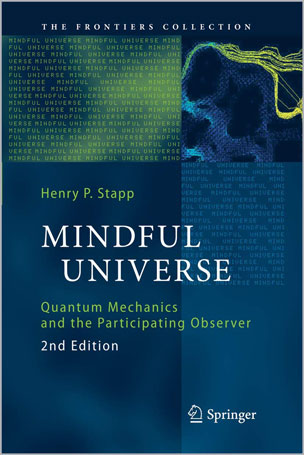
Quantum Mechanics and the Participating Observer
Henry P. Stapp
#Universe
#Quantum_Mechanics
#Quantum_Theory
The classical mechanistic idea of nature that prevailed in science during the eighteenth and nineteenth centuries was an essentially mindless conception: the physically described aspects of nature were asserted to be completely determined by prior physically described aspects alone, with our conscious experiences entering only passively. During the twentieth century the classical concepts were found to be inadequate. In the new theory, quantum mechanics, our conscious experiences enter into the dynamics in specified ways not fixed by the physically described aspects alone. Consequences of this radical change in our understanding of the connection between mind and brain are described. This second edition contains two new chapters investigating the role of quantum phenomena in the problem of free will and in the placebo effect.
Table of Contents
1 Science, Consciousness and Human Values
2 Human Knowledge as the Foundation of Science
3 Actions, Knowledge, and Information
4 Nerve Terminals and the Need to Use Quantum Theory
5 Templates for Action
6 The Physical Effectiveness of Conscious Will and the Quantum Zeno Effect
7 Support from Contemporary Psychology
8 Application to Neuropsychology
9 Roger Penrose's Theory and Quantum Decoherence
10 Non-Orthodox Versions of Quantum Theory and the Need for Process 1
11 The Basis Problem in Many-Worlds Theories
12 Despised Dualism
13 Whiteheadian Quantum Ontology
14 Interview
15 Consciousness and the Anthropic Questions
16 Impact of Quantum Mechanics on Human Values
17 Placebo: A Clinically Significant Quantum Effect
18 Science-Based Discussion of Free Will
A Gazzaniga's The Ethical Brain
B Von Neumann:Knowledge, Information, and Entropy
C Wigner's Friend and Consciousness in Quantum Theory
D Orthodox Interpretation and the Mind--Brain Connection
E Locality in Physics
F Einstein Locality and Spooky Action at a Distance
G Nonlocality in the Quantum World
Henry P. Stapp, author of over three hundred research papers on the mathematical, physical, and philosophical foundations of quantum mechanics, and a Springer book 'Mind, matter, and quantum mechanics'. Worked personally with W. Heisenberg, W. Pauli, and J.A. Wheeler on these issues. Invited author of entries about quantum theories consciousness in several currently about to appear encyclopedias. Invited plenary speaker at numerous international conferences. For book cover: Henry Stapp has spent his entire career working in frontier areas of theoretical physics. After completing his thesis work under Nobel Laureates Emilio Segré and Owen Chamberlain, he joined Wolfgang Pauli to tackle foundational issues. After Pauli's early death, he turned to von Neumann's ideas about the mathematical foundations of quantum theory. The essay 'Mind, Matter and Quantum Mechanics', that developed out of this work eventually evolved into Stapp's classic book bearing the same title. His deep interest in the quantum measurement problem led him to pursue extensive work pertaining to the influence of our conscious thoughts on physical processes occurring in our brains. The understandings achieved in this work have been described in many technical articles and now, in more accessible prose, in the present book.