ثبت نام / ورود
0
ثبت نام / ورود
0
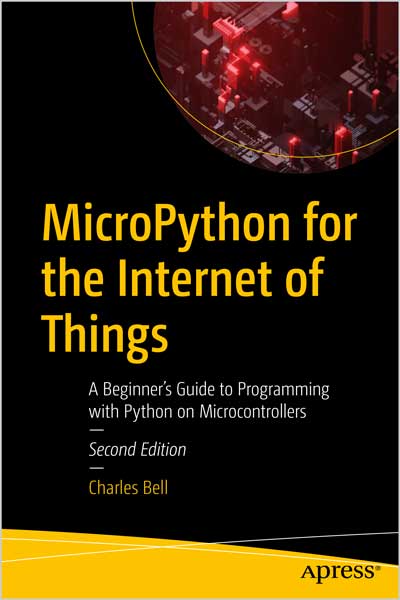
A Beginner’s Guide to Programming with Python on Microcontrollers
Charles Bell
#MicroPython
#Python
#microcontrollers
#IoT
#boards
#sensors
#Raspberry_Pi
#MQTT
This book will help you quickly learn to program for microcontrollers and IoT devices without a lot of study and expense. MicroPython and controllers that support it eliminate the need for programming in a C-like language, making the creation of IoT applications and devices easier and more accessible than ever.
MicroPython for the Internet of Things is ideal for readers new to electronics and the world of IoT. Specific examples are provided covering a range of supported devices, sensors, and MicroPython boards such as the Raspberry Pi Pico and the Arduino Nano Connect RP2040 board. Programming for microcontrollers has never been easier.
The book takes a practical and hands-on approach without a lot of detours into the depths of theory. It’ll show you a faster and easier way to program microcontrollers and IoT devices, teach you MicroPython, a variant of one of the most widely used scripting languages, and is written to be accessible to those new to electronics. After completing this book, and its fun example projects, you’ll be ready to ready to use MicroPython to develop your own IoT applications.
What You Will Learn
Program in MicroPython
Build applications for popular boards such as Raspberry Pi Pico and Arduino Nano Connect RP2040
Connect hardware to software through MicroPython
Who This Book Is For
Anyone interested in building IoT solutions without the heavy burden of programming in C++ or C. The book also appeals to those wanting an easier way to work with hardware than is provided by platforms that require more complex programming environments.
Table of Contents
Chapter 1: What Is the Internet of Things?
Chapter 2: Introducing MicroPython
Chapter 3: MicroPython Hardware
Chapter 4: How to Program in MicroPython
Chapter 5: MicroPython libraries
Chapter 6: Low-Level Hardware Support
Chapter 7: Electronics for Beginners
Chapter 8: Project: Hello, World! MicroPython Style
Chapter 9: Project: Pedestrian Crossing
Chapter 10: Project: Plant Monitoring
Chapter 11: Project: Using Weather Sensors
Chapter 12: Cloud Computing
Chapter 13: Arduino lo T Cloud
Chapter 14: MQTT with Adafruit IO
Chapter 15: ThingSpeak
Chapter 16: Where to Go from Here
Charles Bell conducts research in emerging technologies. He is a member of the Oracle MySQL Development team as a senior developer assisting in the development of MySQL high availability and backup solutions for the MySQL Heatwave services available in the Oracle Cloud Infrastructure. He lives in a small town in rural Virginia with his loving wife. Dr. Bell received his doctorate degree in engineering from Virginia Commonwealth University in 2005. His research interests include database systems, software engineering, sensor networks, and 3D printing. He spends his limited free time as a practicing Maker, focusing on microcontroller and 3D printers and printing projects.