ثبت نام / ورود
0
ثبت نام / ورود
0
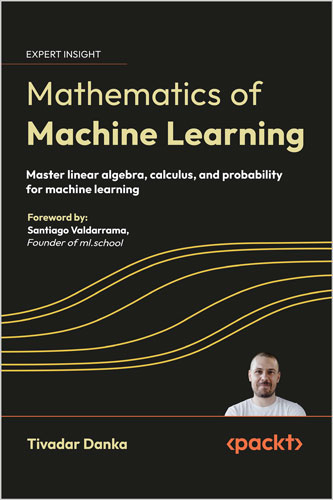
Master linear algebra, calculus, and probability for machine learning
Tivadar Danka
#Mathematics
#Machine_Learning
#Python
#ML
#Linear_algebra
#Complex_numbers
#Matrix
#Matrices
#graphs
#Optimization
#probability
با این راهنمای جامع و کاربردی، پایهای محکم در ریاضیات پشت الگوریتمهای یادگیری ماشین بسازید — شامل جبر خطی، حساب دیفرانسیل و انتگرال، و نظریه احتمال — همراه با مثالهای عملی در پایتون.
کتاب Mathematics of Machine Learning مقدمهای دقیق ولی قابلفهم بر پایههای ریاضی یادگیری ماشین ارائه میدهد — طراحیشده برای مهندسان، توسعهدهندگان و دانشمندان داده که میخواهند دانش فنی خود را ارتقا دهند. در این کتاب، سه حوزهی اصلی ریاضیات یعنی جبر خطی، حساب دیفرانسیل و انتگرال، و نظریهی احتمال بررسی میشوند؛ مفاهیمی که برای درک عمیق الگوریتمهای یادگیری ماشین پیشرفته ضروری هستند.
نویسنده، تیوادر دانکا (Tivadar Danka)، ریاضیدانی با مدرک دکتری که به مهندس یادگیری ماشین تبدیل شده و با سبک آموزش شهودیاش بیش از ۱۰۰ هزار دنبالکننده جذب کرده، مفاهیم پیچیده را با شفافیت توضیح میدهد. این کتاب با ترکیب دقیق نظریه و کاربرد، توضیحاتی روشن از سازههای ریاضی و ارتباط مستقیم آنها با وظایف یادگیری ماشین ارائه میدهد. با مثالهای عملی در پایتون، یاد میگیرید چطور این مفاهیم را پیادهسازی کرده و در سناریوهای واقعی مانند آموزش مدلها با گرادیان نزولی یا کار با بردارها، ماتریسها و تنسورها استفاده کنید.
Build a solid foundation in the core math behind machine learning algorithms with this comprehensive guide to linear algebra, calculus, and probability, explained through practical Python examples
Mathematics of Machine Learning provides a rigorous yet accessible introduction to the mathematical underpinnings of machine learning, designed for engineers, developers, and data scientists ready to elevate their technical expertise. With this book, you’ll explore the core disciplines of linear algebra, calculus, and probability theory essential for mastering advanced machine learning concepts.
PhD mathematician turned ML engineer Tivadar Danka—known for his intuitive teaching style that has attracted 100k+ followers—guides you through complex concepts with clarity, providing the structured guidance you need to deepen your theoretical knowledge and enhance your ability to solve complex machine learning problems. Balancing theory with application, this book offers clear explanations of mathematical constructs and their direct relevance to machine learning tasks. Through practical Python examples, you’ll learn to implement and use these ideas in real-world scenarios, such as training machine learning models with gradient descent or working with vectors, matrices, and tensors.
By the end of this book, you’ll have gained the confidence to engage with advanced machine learning literature and tailor algorithms to meet specific project requirements.
This book is for aspiring machine learning engineers, data scientists, software developers, and researchers who want to gain a deeper understanding of the mathematics that drives machine learning. A foundational understanding of algebra and Python, and basic familiarity with machine learning tools are recommended.
About the Author
Tivadar Danka is a mathematician by training, a machine learning engineer by profession, and an educator by passion. After finishing his PhD in 2016 (about the arcane subject of orthogonal polynomials), he switched career paths and has been working in machine learning ever since. His work includes applying deep learning to cell microscopy images to identify and phenotype cells, creating one of the most popular open source Python packages for active learning, building a full machine learning library from scratch, and collecting about a total of 100k followers on social media, all by posting high-quality educational content.