ثبت نام / ورود
0
ثبت نام / ورود
0
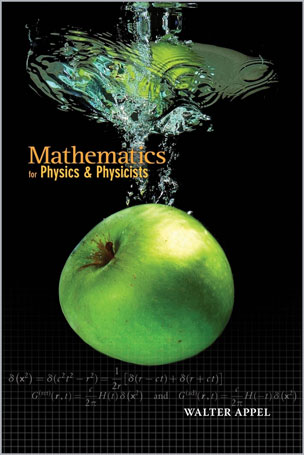
Walter Appel
Translated by: Emmanuel Kowalski
#Mathematics
#Physics
#Physicists
#Tensors
#Groups
#Integral
#Complex_Analysis
What can a physicist gain by studying mathematics? By gathering together everything a physicist needs to know about mathematics in one comprehensive and accessible guide, this is the question Mathematics for Physics and Physicists successfully takes on.
The author, Walter Appel, is a renowned mathematics educator hailing from one of the best schools of France's prestigious Grandes écoles, where he has taught some of his country's leading scientists and engineers. In this unique book, oriented specifically toward physicists, Appel shows graduate students and researchers the vital benefits of integrating mathematics into their study and experience of the physical world. His approach is mathematically rigorous yet refreshingly straightforward, teaching all the math a physicist needs to know above the undergraduate level. Appel details numerous topics from the frontiers of modern physics and mathematics--such as convergence, Green functions, complex analysis, Fourier series and Fourier transform, tensors, and probability theory--consistently partnering clear explanations with cogent examples. For every mathematical concept presented, the relevant physical application is discussed, and exercises are provided to help readers quickly familiarize themselves with a wide array of mathematical tools.
Mathematics for Physics and Physicists is the resource today's physicists must have to strengthen their math skills and to gain otherwise unattainable insights into their fields of study.
Table of Contents
1. Reminders: convergence of sequences and series
2. Measure theory and the Lebesgue integral
3. Integral calculus
4. Complex Analysis I
5. Complex Analysis II
6. Conformal maps
7. Distributions I
8. Distributions II
9. Hilbert spaces; Fourier series
10. Fourier transform of functions
11. Fourier transform of distributions
12. The Laplace transform
13. Physical applications of the Fourier transform
14. Bras, kets, and all that sort of thing
15. Green functions
16. Tensors
17. Differential forms
18. Groups and group representations
19. Introduction to probability theory
20. Random variables
21. Convergence of random variables: central limit theorem
Appendix A. Reminders concerning topology and normed vector spaces
Appendix B. Elementary reminders of differential calculus
Appendix C. Matrices
Appendix D. A few proofs
"This nicely organized and pedagogically excellent book not only covers material that students of physics and engineering are conventionally assumed to need at an advanced undergraduate and graduate level but goes beyond that by including some important modern mathematics not usually included in such texts―such as Lebesgue integration, theory of distributions, probability theory, and differential geometry. It treats the material in a rigorous yet friendly manner from a physicist's perspective, and even includes interesting historical asides that convey to a student the idea that mathematics is not a dead subject. It is an excellent choice as a course textbook or as an addition to a physicist's bookshelf."―Elliott Lieb, Princeton University
"As happens to many of us who teach a mathematics for physicists course to physics students, Appel―who for years taught such a course at the école Normale Supérieure de Lyon―faced the problem of finding a textbook that is neither too soft or imprecise nor too specialized mathematically. This book is Appel's own elegant way out of this dilemma. Physics students at the graduate level will benefit handsomely."―Michael Kiessling, Rutgers University
"Mathematics for Physics and Physicists gives a charming exposition of many important concepts, including topics not covered in standard textbooks. Appel finds an excellent balance between mathematical rigor and physical applications, and the book is interspersed with short biographies of mathematicians and sets of illustrative problems. I wish that kind of book had been available when I was a student."―Andreas Brandhuber, Queen Mary, University of London
Walter Appel holds a Ph.D. in theoretical physics. He taught mathematics for physics for seven years at the École Normale Supérieure de Lyon in France and currently teaches mathematics at the Henri Poincaré School.