ثبت نام / ورود
0
ثبت نام / ورود
0
John Vince
#Mathematics
#Computer_Graphics
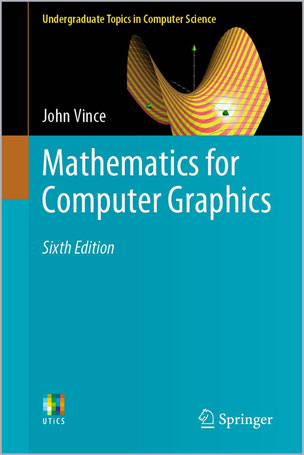
John Vince explains a comprehensive range of mathematical techniques and problem-solving strategies associated with computer games, computer animation, special effects, virtual reality, CAD and other areas of computer graphics in this completely revised and expanded sixth edition.
The first five chapters cover a general introduction, number sets, algebra, trigonometry and coordinate systems, which are employed in the following chapters on determinants, vectors, matrix algebra, complex numbers, geometric transforms, quaternion algebra, quaternions in space, interpolation, curves and patches, analytical geometry and barycentric coordinates. Following this, the reader is introduced to the relatively new subject of geometric algebra, followed by two chapters that introduce differential and integral calculus. Finally, there is a chapter on worked examples.
Mathematics for Computer Graphics covers all of the key areas of the subject, including:
This sixth edition contains approximately 150 worked examples and over 330 colour illustrations, which are central to the author’s descriptive writing style. Mathematics for Computer Graphics provides a sound understanding of the mathematics required for computer graphics software and setting the scene for further reading of more advanced books and technical research papers.
Table of Contents
1 Introduction
2 Numbers
3 Algebra
4 Trigonometry
5 Coordinate Systems
6 Determinants
7 Vectors
8 Matrix Algebra
9 Complex Numbers
10 Geometric Transforms
11 Quaternion Algebra
12 Quaternions in Space
13 Interpolation
14 Curves and Patches
15 Analytic Geometry
16 Barycentric Coordinates
17 Geometric Algebra
18 Calculus: Derivatives
19 Calculus: Integration
20 Worked Examples
Appendix A Limit of (sin8)/8
Appendix B Integrating cosn8
Professor John Vince began working in computer graphics at Middlesex Polytechnic in 1968. His research activities centered on computer animation software and resulted in the PICASO and PRISM animation systems. Whilst at Middlesex, he designed the UK’s first MSc course in Computer Graphics and developed a popular program of short courses in computer animation for television designers. In 1986 he joined Rediffusion Simulation as a Research Consultant and worked on the development of real-time computer systems for commercial flight simulators. In 1992 he was appointed Chief Scientist of Thomson Training Simulation Ltd. In 1995 he was appointed Professor of Digital Media at the National Centre for Computer Animation at Bournemouth University and in 1999 he was made Head of Academic Group for Computer Animation. He was awarded a DSc by Brunel University in recognition of his work in computer graphics.