ثبت نام / ورود
0
ثبت نام / ورود
0
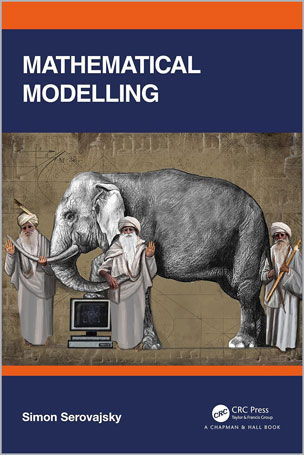
Simon Serovajsky
#Mathematical
#Modelling
#Calculations
#Mechanical
Mathematical Modelling sets out the general principles of mathematical modelling as a means comprehending the world. Within the book, the problems of physics, engineering, chemistry, biology, medicine, economics, ecology, sociology, psychology, political science, etc. are all considered through this uniform lens.
The author describes different classes of models, including lumped and distributed parameter systems, deterministic and stochastic models, continuous and discrete models, static and dynamical systems, and more. From a mathematical point of view, the considered models can be understood as equations and systems of equations of different nature and variational principles. In addition to this, mathematical features of mathematical models, applied control and optimization problems based on mathematical models, and identification of mathematical models are also presented.
Features
Table of Contents
1. Foundations of mathematical modeling
Part I. Systems with lumped parameters
2. Approximate solving of differential equations
3. Mechanical oscillations
4. Electrical oscillations
5. Elements of dynamical system theory
6. Mathematical models in chemistry
7. Mathematical model in biology
8. Mathematical model of economics
9. Mathematical models in social sciences
Part II. Systems with distributed parameters
10. Mathematical models of transfer processes. 1
11. Mathematical models of transfer processes. 2
12. Wave processes
13. Mathematical models of stationary systems
14. Mathematical models of fluid and gas mechanics
15. Mathematical models of quantum mechanical systems
Part III. Other mathematical models
16. Variational principles
17. Discrete models
18. Stochastic models
Part IV. Additions
19. Mathematical problems of mathematical models
20. Optimal control problems
21. Identification of mathematical models
Simon Serovajsky is a professor of mathematics at al-Farabi Kazakh National University in Kazakhstan. He is the author of many books published in the area of optimization and optimal control theory, mathematical physics, mathematical modelling, philosophy and history of mathematics as well as a long list of high-quality publications in learned journals.