ثبت نام / ورود
0
ثبت نام / ورود
0
V.I. Arnold
Translators: K. Vogtmann, A. Weinstein
#Mathematical_Methods
#Classical_Mechanics
#Lagrangian
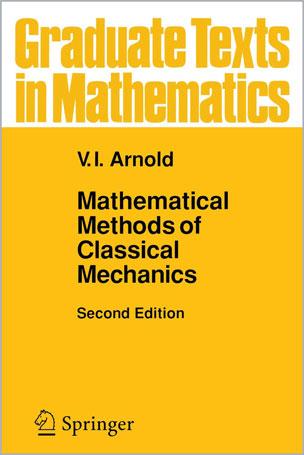
In this text, the author constructs the mathematical apparatus of classical mechanics from the beginning, examining all the basic problems in dynamics, including the theory of oscillations, the theory of rigid body motion, and the Hamiltonian formalism. This modern approch, based on the theory of the geometry of manifolds, distinguishes iteself from the traditional approach of standard textbooks. Geometrical considerations are emphasized throughout and include phase spaces and flows, vector fields, and Lie groups. The work includes a detailed discussion of qualitative methods of the theory of dynamical systems and of asymptotic methods like perturbation techniques, averaging, and adiabatic invariance.
Table of Contents
Part I NEWTONIAN MECHANICS
Chapter I Experimental facts
Chapter 2 Investigation of the equations of motion
Part II LAGRANGIAN MECHANICS
Chapter 3 Variational principles
Chapter 4 Lagrangian mechanics on manifolds
Chapter 5 Oscillations
Chapter 6 Rigid bodies
Part III HAMILTONIAN MECHANICS
Chapter 7 Differential forms
Chapter 8 Symplectic manifolds
Chapter 9 Canonical formalism
Chapter 10 Introduction to perturbation theory
About the Author
Vladimir I. Arnold was a Soviet and Russian mathematician. He is best known for the Kolmogorov–Arnold–Moser theorem regarding the stability of integrable systems, and contributed to several areas, including geometrical theory of dynamical systems theory, algebra, catastrophe theory, topology, real algebraic geometry, symplectic geometry, symplectic topology, differential equations, classical mechanics, differential geometric approach to hydrodynamics, geometric analysis and singularity theory, including posing the ADE classification problem.
His first main result was the solution of Hilbert's thirteenth problem in 1957 at the age of 19. He co-founded three new branches of mathematics: topological Galois theory (with his student Askold Khovanskii), symplectic topology and KAM theory.
Arnold was also known as a popularizer of mathematics. Through his lectures, seminars, and as the author of several textbooks (such as Mathematical Methods of Classical Mechanics) and popular mathematics books, he influenced many mathematicians and physicists.[5][6] Many of his books were translated into English. His views on education were particularly opposed to those of Bourbaki.