ثبت نام / ورود
0
ثبت نام / ورود
0
#Math
#Python
#data_science
#machine_learning
#computer_graphics
#cryptography
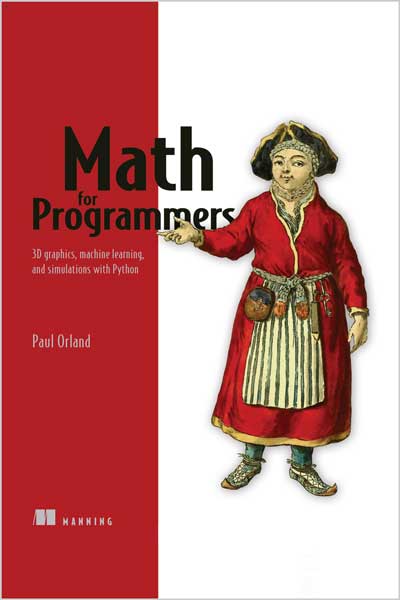
To score a job in data science, machine learning, computer graphics, and cryptography, you need to bring strong math skills to the party. Math for Programmers teaches the math you need for these hot careers, concentrating on what you need to know as a developer.
Filled with lots of helpful graphics and more than 200 exercises and mini-projects, this book unlocks the door to interesting-and lucrative!-careers in some of today’s hottest programming fields.
Skip the mathematical jargon: This one-of-a-kind book uses Python to teach the math you need to build games, simulations, 3D graphics, and machine learning algorithms. Discover how algebra and calculus come alive when you see them in code!
In Math for Programmers you’ll explore important mathematical concepts through hands-on coding. Filled with graphics and more than 200 exercises and mini-projects, this book unlocks the door to interesting–and lucrative!–careers in some of today’s hottest fields. As you tackle the basics of linear algebra, calculus, and machine learning, you’ll master the key Python libraries used to turn them into real-world software applications.
Table of contents
1. Learning Math with Code
Part 1: Vectors and Graphics
2. Drawing with 20 Vectors
3. Ascending to the 30 World
4. Transforming Vectors and Graphics
5. Computing Transformations with Matrices
6. Generalizing to Higher Dimensions
7. Solving Systems of Linear Equations
Part 2: Calculus and Physical Simulation
8. Understanding Rates of Change
9. Simulating Moving Objects
10. Working with Symbolic Expressions
11. Simulating Force Fields
12. Optimizing A Physical System
13. Analyzing Sound Waves with A Fourier Series
Part 3: Machine Learning Applications
14. Fitting Functions to Data
15. Classifying Data with Logistic Regression
16. Training Neural Networks