ثبت نام / ورود
0
ثبت نام / ورود
0
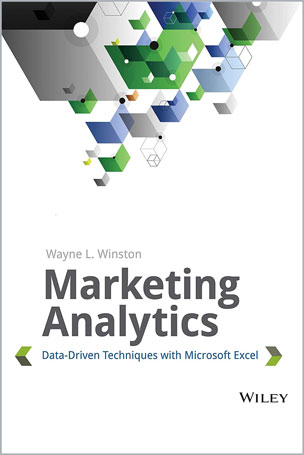
Data-Driven Techniques with Microsoft Excel
Wayne L. Winston
#Marketing
#Data-Driven
#Microsoft
#Excel
#Pricing
#Product
#Advertising
#PCA
#ANOVA
Helping tech-savvy marketers and data analysts solve real-world business problems with Excel
Using data-driven business analytics to understand customers and improve results is a great idea in theory, but in today's busy offices, marketers and analysts need simple, low-cost ways to process and make the most of all that data. This expert book offers the perfect solution. Written by data analysis expert Wayne L. Winston, this practical resource shows you how to tap a simple and cost-effective tool, Microsoft Excel, to solve specific business problems using powerful analytic techniques―and achieve optimum results.
Practical exercises in each chapter help you apply and reinforce techniques as you learn.
Improve your marketing results with Microsoft Excel and the invaluable techniques and ideas in Marketing Analytics: Data-Driven Techniques with Microsoft Excel.
Table of Contents
Part I Using Excel to Summarize Marketing Data
Chapter 1 Slicing and Dicing Marketing Data with PivotTables
Chapter 2 Using Excel Charts to Summarize Marketing Data
Chapter 3 Using Excel Functions to Summarize Marketing Data
Part II Pricing
Chapter 4 Estimating Demand CuNes and Using Solver to Optimize Price
Chapter 5 Price Bundling
Chapter 6 Nonlinear Pricing
Chapter 7 Price Skimming and Sales
Chapter 8 Revenue Management
Part Ill Forecasting
Chapter 9 Simple Linear Regression and Correlation
Chapter 10 Using Multiple Regression to Forecast Sales
Chapter 11 Forecasting in the Presence of Special Events
Chapter 12 Modeling Trend and Seasonality
Chapter 13 Ratio to Moving Average Forecasting Method
Chapter 14 Winter's Method
Chapter 15 Using Neural Networks to Forecast Sales
Part IV What do Customers Want?
Chapter 16 Conjoint Analysis
Chapter 17 Logistic Regression
Chapter 18 Discrete Choice Analysis
Part V Customer Value
Chapter 19 Calculating Lifetime Customer Value
Chapter 20 Using Customer Value to Value a Business
Chapter 21 Customer Value, Monte Carlo Simulation, and Marketing Decision Making
Chapter 22 Allocating Marketing Resources between Customer Acquisition and Retention
Part VI Market Segmentation
Chapter 23 Cluster Analysis
Chapter 24 Collaborative Filtering
Chapter 25 Using Classification Trees for Segmentation
Part VI Market Segmentation
Chapter 23 Cluster Analysis
Chapter 24 Collaborative Filtering
Chapter 25 Using Classification Trees for Segmentation
Part VII Forecasting New Product Sales
Chapter 26 Using S Curves to Forecast Sales of a New Product
Chapter 27 The Bass Diffusion Model
Chapter 28 Using the Copernican Principle to Predict Duration of Future Sales
Part VIII Retailing
Chapter 29 Market Basket Analysis and Lift
Chapter 30 RFM Analysis and Optimizing Direct Mail Campaigns
Chapter 31 Using the SCAN*PRO Model and Its Variants
Chapter 32 Allocating Retail Space and Sales Resources
Chapter 33 Forecasting Sales from Few Data Points
Part IX Advertising
Chapter 34 Measuring the Effectiveness of Advertising
Chapter 35 Media Selection Models
Chapter 36 Pay per Click (PPC) Online Advertising
Part X Marketing Research Tools
Chapter 37 Principal Components Analysis (PCA)
Chapter 38 Multidimensional Scaling (MDS)
Chapter 39 Classification Algorithms: Naive Bayes Classifier and Discriminant Analysis
Chapter 40 Analysis of Variance: One-way ANOVA
Chapter 41 Analysis of Variance: Two-way ANOVA
Part XI Internet and Social Marketing
Chapter 42 Networks
Chapter 43 The Mathematics Behind The Tipping Point
Chapter 44 Viral Marketing
Chapter 45 Text Mining
Wayne L. Winston is John and Esther Reese chaired Professor of Decision Sciences at the Indiana University Kelley School of Business and will be a Visiting Professor at the Bauer College of Business at the University of Houston. He has won more than 45 teaching awards at Indiana University. He has also written numerous journal articles and a dozen books, and has developed two online courses for Harvard Business School.