ثبت نام / ورود
0
ثبت نام / ورود
0
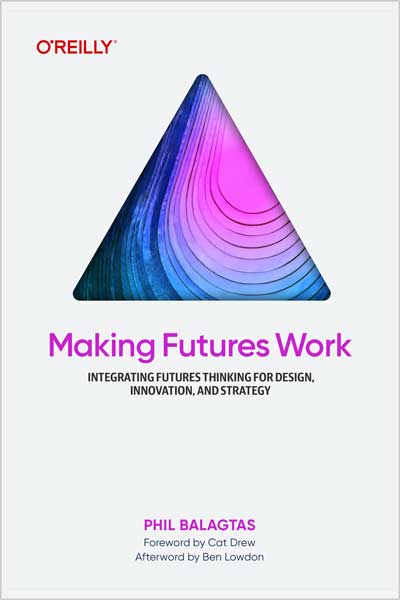
Integrating Futures Thinking for , Innovation, and Strategy
Phil Balagtas
#Design
#Work
#Strategy
#IBM
#Apple
#Disney
#Designing_Strategy
Learn how to get started with Futures Thinking. With this practical guide, Phil Balagtas, founder of the Design Futures Initiative and the global Speculative Futures network, shows you how designers and futurists have made futures work at companies such as Atari, IBM, Apple, Disney, Autodesk, Lufthansa, and McKinsey & Company.
This book demystifies the process of Futures Thinking into a language that's practical and useful for both designers and strategists. You'll learn about Strategic Foresight for using ideas about the future to anticipate and prepare for change; explore Speculative Design to deal with the relationship between science, technology, and humans; and Design Fiction to explore and critique possible futures.
Balagtas also shares stories from his journey to build a global community and describes how he works with clients to reshape the futures vocabulary. With this guide, you'll learn how to:
Table of Contents
Chapter 1. A Fascination with the Future
Chapter 2. A Primer on Process and Approach
Stage 0. Preparing for Futures Work
Stage 1. Strategic Foresight
Stage 2. Designing Futures
Stage 3. Designing Strategy
Who This Book Is For
This book is primarily for designers and design leaders—those with a background in digital and product design, strategy design, service design, or experience design, and who have at least a few years’ experience as a practitioner. I say this because designers might not necessarily be interested in strategic thinking early in their careers. Those who have had some time to hone their craft and are looking to expand their role or capabilities with strategy and innovation processes will likely be more prepared to pick this book up and run with it. Designers are the community I have built my career around and whom I am usually speaking to or teaching. That said, this book is really for anyone who is interested in getting started in learning about Futures Thinking. Managers, executive leaders, and other strategic thinkers can certainly benefit from the content.
The book is also for those who have worked internally (in-house) and/or externally (consultants) and will provide different perspectives on how things might change if you are using futures within a team or as an outside practitioner advising an organization. Since the workforce landscape is constantly evolving, new roles are being created every day; thus I’m not limiting the audience for this book to any one type of specialization. That said, it is written from a designer’s perspective and includes vocabulary and methods that designers might be more familiar with. However, I discuss many concepts that don’t require a design degree to understand.
This book is primarily for designers and design leaders—those with a background in digital and product design, strategy design, service design, or experience design, and who have at least a few years’ experience as a practitioner. I say this because designers might not necessarily be interested in strategic thinking early in their careers. Those who have had some time to hone their craft and are looking to expand their role or capabilities with strategy and innovation processes will likely be more prepared to pick this book up and run with it. Designers are the community I have built my career around and whom I am usually speaking to or teaching. That said, this book is really for anyone who is interested in getting started in learning about Futures Thinking. Managers, executive leaders, and other strategic thinkers can certainly benefit from the content. The book is also for those who have worked internally (in-house) and/or externally (consultants) and will provide different perspectives on how things might change if you are using futures within a team or as an outside practitioner advising an organization. Since the workforce landscape is constantly evolving, new roles are being created every day; thus I’m not limiting the audience for this book to any one type of specialization. That said, it is written from a designer’s perspective and includes vocabulary and methods that designers might be more familiar with. However, I discuss many concepts that don’t require a design degree to understand.
Thus, if you find value in the content, by all means use this book, whether as a quick-start guide, a workshop manual, a textbook, or a strategic process guide. It was written to be as practical and usable as possible, without extraneous commentary, philosophy, or political stances. Other than the occasional quip about the usefulness of a method or principle or the observation that futures should be used to do more good in the world, I have tried to refrain from overly pontificating about futures as a cure-all. Essentially, the book is meant to be used as a supplement to your current tools and processes. Whether you want to think more strategically or just need a few more ways to consider alternative ideas or perspectives, I hope you’ll find something in here that is useful. I do not intend to claim (other than in the necessary legal copyrights of this book) any stake in or ownership of any proposed method, framework, or terminology. Most of the content has been referenced, credited, or taken from public commons. With that, I encourage you to share this content with anyone who might find it valuable.
Phil Balagtas is a design leader with over 2 decades of experience creating innovative digital products and services. Working for companies such as General Electric and McKinsey & Company, he has served a variety of sectors such as aviation, healthcare, utilities, consumer electronics, and retail to name a few. As a consultant he has helped transform businesses through cultural and digital transformations, trained teams on Design Thinking and designed and shipped digital products for B2B and B2C organizations.
He is also the founder of the Design Futures Initiative, a nonprofit based in San Francisco focused on the advancement of Futures Thinkingâ??principles and methodologies for assessing the threats and opportunities of the future. Through this initiative he has worked with the United Nations, Boys & Girls Club of San Francisco and also founded a global network of Futures Thinking chapters called Speculative Futures. Working as both a Futures expert, evangelist and consultant, he has been studying and applying Futures to a variety of business and organizational contexts in an attempt to integrate it into the design practice and make the approach more practical, accessible and viable for business and product strategy.