ثبت نام / ورود
0
ثبت نام / ورود
0
Charles Platt
#Electronics
#circuits
#Beginners
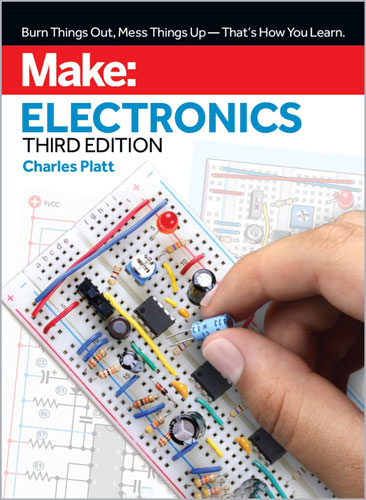
The first edition of Make: Electronics established a new benchmark for introductory texts. The second edition enhanced that experience, and now this third edition includes all-new diagrams throughout, new photographs, and completely rewritten text.
Learning by Discovery is a system developed by Charles Platt to enable an experience that is fascinating, fun, and memorable. You learn by building your own circuits--and by making your own mistakes.
In fact, mistakes are an important part of the experience. The book encourages you to "burn things out and mess things up" to find out for yourself the limits of electronic components. You'll blow a fuse and watch an overloaded LED, and you can cut open a relay to see how it works inside.
Affordable Component Kits are available from independent suppliers (on Amazon), or the book explains how to shop online yourself.
Illustrations are in full color throughout, so you'll see exactly what you need and how to use it.
While Make: Electronics minimizes the amount of theory that you need, it does show you how to figure out Ohm's Law and do the simple math to calculate the time constant of a capacitor.
A buying guide shows basic tools ranging from pliers to a low cost multimeter. A simple "finger test" demonstrates how transistors switch or amplify current. You can solder wires, if you wish, to build a permanent circuit, although soldering is not necessary to build all the circuits in the book.
You'll see how to use integrated circuit chips to create a simple circuit that tests the speed of your reflexes. Other circuits include a combination lock for a computer, or a game in which players compete to be the first to press a button.
All the basic concepts are demonstrated quickly and simply with affordable components. You'll discover resistance, capacitance, voltage, amperage, inductance, and the relationship between electricity and magnetism.
Ideal for Beginners
This book assumes that you have no prior knowledge. It explains each concept in meticulous detail, and is friendly, patient, and fun. Positive reader feedback has been received from people ranging in age from 8 to 84. If you only buy one book about electronics, this should be the one.
Table of Contents
Section One: The Basics
Experiment 1: Taste the Power!
Experiment 2: Go with the Flow
Experiment 3: Applying Pressure
Experiment 4: Heat and Power
Experiment 5: Let's Make a Battery
Section Two: Switching
Experiment 6: Getting Connected
Experiment 7: Investigating a Relay
Experiment 8: A Relay Oscillator
Experiment 9: Time and Capacitors
Experiment 10: Transistor Switching
Experiment 11: Light and Sound
Section Three: Soldering
Experiment 12: Joining Two Wires Together
Experiment 13: Roasting an LED
Experiment 14: A Wearable Multivibrator
Section Four: Chips, Ahoy!
Experiment 15: Emitting a Pulse
Experiment 16: Set Your Tone
Experiment 17: An Alarming Idea
Experiment 18: Reflex Tester
Experiment 19: Learning Logic
Experiment 20: The Unlocker
Experiment 21: The Button Blocker
Experiment 22: Flipping and Bouncing
Experiment 23: Nice Dice
Section Five: What Next?
Experiment 24: Magnetism
Experiment 25: Tabletop Power Generation
Experiment 26: Speaker Destruction
Experiment 27: Making a Coil React
Experiment 28: One Radio, No Solder,No Power
Experiment 29: Hardware Meets Software
Experiment 30: Nicer Dice
Chapter 31: The Learning Process
Appendix A: Specifications
Appendix B: Sources
Charles Platt is a contributing editor and regular columnist for Make: magazine, where he writes about electronics and tools. Platt was a senior writer for Wired magazine, has written various computer books, and has been fascinated by electronics since he put together a telephone answering machine from a tape recorder and military-surplus relays at age 15. He lives in a Northern Arizona wilderness area, where he has his own workshop for prototype fabrication and the projects that he writes about for Make: magazine.