ثبت نام / ورود
0
ثبت نام / ورود
0
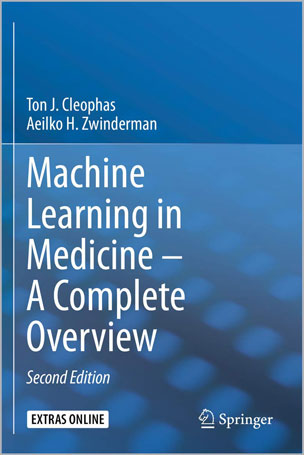
Ton J. Cleophas, Aeilko H. Zwinderman
#Machine_Learning
#Medicine
#K-Means
#SO_Patients
#SEM
#DNA
Adequate health and health care is no longer possible without proper data supervision from modern machine learning methodologies like cluster models, neural networks, and other data mining methodologies. The current book is the first publication of a complete overview of machine learning methodologies for the medical and health sector, and it was written as a training companion, and as a must-read, not only for physicians and students, but also for any one involved in the process and progress of health and health care.
In this second edition the authors have removed the textual errors from the first edition. Also, the improved tables from the first edition, have been replaced with the original tables from the software programs as applied. This is, because, unlike the former, the latter were without error, and readers were better familiar with them.
The main purpose of the first edition was, to provide stepwise analyses of the novel methods from data examples, but background information and clinical relevance information may have been somewhat lacking. Therefore, each chapter now contains a section entitled "Background Information".
Machine learning may be more informative, and may provide better sensitivity of testing than traditional analytic methods may do. In the second edition a place has been given for the use of machine learning not only to the analysis of observational clinical data, but also to that of controlled clinical trials.Unlike the first edition, the second edition has drawings in full color providing a helpful extra dimension to the data analysis.
Several machine learning methodologies not yet covered in the first edition, but increasingly important today, have been included in this updated edition, for example, negative binomial and Poisson regressions, sparse canonical analysis, Firth's bias adjusted logistic analysis, omics research, eigenvalues and eigenvectors.
Table of Contents
Part I: Cluster and Classification Models
Chapter 1: Hierarchical Clustering and K-Means Clustering to Identify Subgroups in Surveys (SO Patients)
Chapter 2: Density-Based Clustering to Identify Outlier Groups in Otherwise Homogeneous Data (SO Patients)
Chapter 3: Two Step Clustering to Identify Subgroups and Predict Subgroup Memberships in Individual Future Patients (120 Patie ...
Chapter 4: Nearest Neighbors for Classifying New Medicines (2 New and 25 Old Opioids)
Chapter 5: Predicting High-Risk-Bin Memberships (1445 Families)
Chapter 6: Predicting Outlier Memberships (2000 Patients)
Chapter 7: Data Mining for Visualization of Health Processes (150 Patients)
Chapter 8: Trained Decision Trees for a More Meaningful Accuracy (150 Patients)
Chapter 9: Typology of Medical Data (51 Patients)
Chapter 10: Predictions from Nominal Clinical Data (450 Patients)
Chapter 11: Predictions from Ordinal Clinical Data (450 Patients)
Chapter 12: Assessing Relative Health Risks (3000 Subjects)
Chapter 13: Measuring Agreement (30 Patients)
Chapter 14: Column Proportions for Testing Differences between Outcome Scores (450 Patients)
Chapter 15: Pivoting Trays and Tables for Improved Analysis of Multidimensional Data (450 Patients)
Chapter 16: Online Analytical Procedure Cubes. a More Rapid Approach to Analyzing Frequencies (450 Patients)
Chapter 17: Restructure Data Wizard for Data Classified the Wrong Way (20 Patients)
Chapter 18: Control Charts for Quality Control of Medicines (164 Tablet Desintegration Times)
Part II: (Log) Linear Models
Chapter 19: Linear, Logistic, and Cox Regression for Outcome Prediction with Unpaired Data (20, 55, and 60 Patients)
Chapter 20: Generalized Linear Models for Outcome Prediction with Paired Data (100 Patients and 139 Physicians)
Chapter 21: Generalized Linear Models Event-Rates (50 Patients)
Chapter 22: Factor Analysis and Partial Least Squares (PLS) for Complex-Data Reduction (250 Patients)
Chapter 23: Optimal Scaling of High-sensitivity Analysis of Health Predictors (250 Patients)
Chapter 24: Discriminant Analysis for Making a Diagnosis from Multiple Outcomes (45 Patients)
Chapter 25: Weighted Least Squares for Adjusting Efficacy Data with Inconsistent Spread (78 Patients)
Chapter 26: Partial Correlations for Removing Interaction Effects from Efficacy Data (64 Patients)
Chapter 27: Canonical Regression for Overall Statistics from Multivariate Data (250 Patients)
Chapter 28: Multinomial Regression for Outcome Categories (55 Patients)
Chapter 29: Various Methods for Analyzing Predictor Categories (60 and 30 Patients)
Chapter 30: Random Intercept Models for Both Outcome and Predictor Categories (55 Patients)
Chapter 31: Automatic Regression for Maximizing Linear Relationships (55 Patients)
Chapter 32: Simulation Models for Varying Predictors (9000 Patients)
Chapter 33: Generalized Linear Mixed Models for Outcome Prediction from Mixed Data (20 Patients)
Chapter 34: Two-stage Least Squares (35 Patients)
Chapter 35: Autoregressive Models for Longitudinal Data (120 Mean Monthly Population Records)
Chapter 36: Variance Components for Assessing the Magnitude of Random Effects (40 Patients)
Chapter 37: Ordinal Scaling for Clinical Scores with Inconsistent Intervals (900 Patients)
Chapter 38: Loglinear Models for Assessing Incident Rates with Varying Incident Risks (12 Populations)
Chapter 39: Logit Loglinear and Hierarchical Loglinear Modeling for Outcome Categories (445 Patients)
Chapter 40: More on Polytomous Outcome Regressions (450 Patients)
Chapter 41: Heterogeneity in Clinical Research: Mechanisms Responsible (20 Studies)
Chapter 42: Performance Evaluation of Novel Diagnostic Tests (650 and 588 Patients)
Chapter 43: Quantile-Quantile Plots, a Good Start for Looking at your Medical Data (50 Cholesterol Measurements and 58 Patient...
Chapter 44: Rate Analysis of Medical Data Better than Risk Analysis (52 Patients)
Chapter 45: Trend Tests Will Be Statistically Significant if Traditional fasts Are Not (30 and 106 Patients)
Chapter 46: Doubly Multivariate Analysis of Variance for Multiple Observations from Multiple Outcome Variables (16 Patients)
Chapter 47: Probit Models for Estimating Effective Pharmacological Treatment Dosages (14 Tests)
Chapter 48: Interval Censored Data Analysis for Assessing Mean Time to Cancer Relapse (51 Patients)
Chapter 49: Structural Equation Modeling (SEM) with SPSS Analysis of Moment Structures (Amos) Software for Cause Effect Relati...
Chapter 50: Structural Equation Modeling (SEM) with SPSS Analysis of Moment Structures (Amos) Software for Cause Effect Relati...
Chapter 51: Firth's Bias-adjusted Estimates for Biased Logistic Data Models (23 Challenger Launchings)
Chapter 52: Omics Research (125 Patients, 24 Predictor Variables)
Chapter 53: Sparse Canonical Correlation Analysis
Chapter 54: Eigenvalues, Eigenvectors and Eigenfunctions (45 and 250 Patients)
Part Ill: Rules Models
Chapter 55: Neural Networks for Assessing Relationships that are Typically Nonlinear (90 Patients)
Chapter 56: Complex Samples Methodologies for Unbiased Sampling (9678 Persons)
Chapter 57: Correspondence Analysis for Identifying the Best of Multiple Treatments in Multiple Groups (217 Patients)
Chapter 58: Decision Trees for Decision Analysis {1004 and 953 Patients)
Chapter 59: Multidimensional Scaling for Visualizing Experienced Drug Efficacies (14 Pain-killers and 42 Patients)
Chapter 60: Stochastic Processes for Long Term Predictions from Short Term Observations
Chapter 61: Optimal Binning for Finding High Risk Cut-offs (1445 Families)
Chapter 62: Conjoint Analysis for Determining the Most Appreciated Properties of Medicines to Be Developed (15 Physicians)
Chapter 63: Item Response Modeling for Analyzing Quality of Life with Better Precision (1000 Patients)
Chapter 64: Survival Studies with Varying Risks of Dying (SO and 60 Patients)
Chapter 65: Fuzzy Logic for Improved Precision of Dose-Response Data (8 Induction Dosages)
Chapter 66: Automatic Data Mining for the Best Treatment of a Disease (90 Patients)
Chapter 67: Pareto Charts for Identifying the Main Factors of Multifactorial Outcomes (2000 Admissions to Hospital)
Chapter 67: Pareto Charts for Identifying the Main Factors of Multifactorial Outcomes {2000 Admissions to Hospital)
Chapter 68: Radial Basis Neural Networks for Multidimensional Gaussian Data {90 Persons)
Chapter 69: Automatic Modeling of Drug Efficacy Prediction {250 Patients)
Chapter 70: Automatic Modeling for Clinical Event Prediction {200 Patients)
Chapter 71: Automatic Newton Modeling in Clinical Pharmacology (1 5 Alf en ta nil Dosages, 15 Quinidine Time-Concentration Relatio ...
Chapter 72: Spectral Plots for High Sensitivity Assessent of Periodicity (6 Years' Monthly C Reactive Protein Levels)
Chapter 73: Runs Test for Identifying Best Regression Models {21 Estimates of Quantity and Quality of Patient Care)
Chapter 74: Evolutionary Operations for Process Improvement (8 Operation Room Air Condition Settings)
Chapter 75: Bayesian Networks for Cause Effect Modeling {600 Patients)
Chapter 76: Support Vector Machines for Imperfect Nonlinear Data (200 Patients with Sepsis)
Chapter 77: Multiple Response Sets for Visualizing Clinical Data Trends {811 Patient Visits)
Chapter 78: Protein and DNA Sequence Mining
Chapter 79: Iteration Methods for Crossvalidations {150 Patients with Pneumonia)
Chapter 80: Improving Parallel-Groups with Different Sample Sizes and Variances (5 Parallel-Group Studies)
Chapter 81: Association Rules Between Exposure and Outcome {50 and 60 Patients)
Chapter 82: Confidence Intervals for Proportions and Differences in Proportions {100 and 75 Patients)
Chapter 83: Ratio Statistics for Efficacy Analysis of New Drugs {SO Patients)
Chapter 84: Fifth Order Polynomes of Circadian Rhythms (1 Patient with Hypertension)
Chapter 85: Gamma Distribution for Estimating the Predictors of Medical Outcome Scores (110 Patients)