ثبت نام / ورود
0
ثبت نام / ورود
0
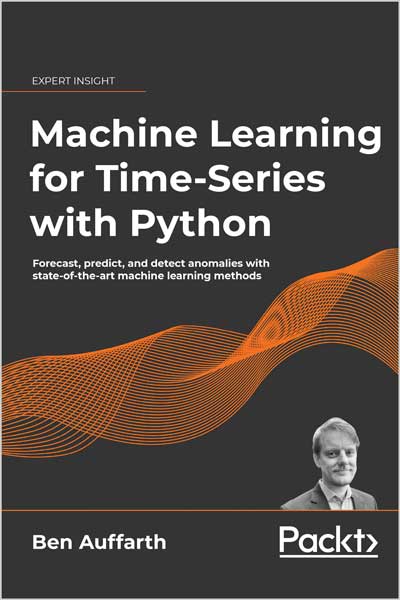
Forecast, predict, and detect anomalies with state-of-the-art machine learning methods
Ben Auffarth
#Machine_Learning
#Time-Series
#Python
#ARMA
#ARIMA
#XGboost
#TensorFlow
#operations_management
#digital_marketing
#finance
#healthcare
Get better insights from time-series data and become proficient in model performance analysis
The Python time-series ecosystem is huge and often quite hard to get a good grasp on, especially for time-series since there are so many new libraries and new models. This book aims to deepen your understanding of time series by providing a comprehensive overview of popular Python time-series packages and help you build better predictive systems.
Machine Learning for Time-Series with Python starts by re-introducing the basics of time series and then builds your understanding of traditional autoregressive models as well as modern non-parametric models. By observing practical examples and the theory behind them, you will become confident with loading time-series datasets from any source, deep learning models like recurrent neural networks and causal convolutional network models, and gradient boosting with feature engineering.
This book will also guide you in matching the right model to the right problem by explaining the theory behind several useful models. You'll also have a look at real-world case studies covering weather, traffic, biking, and stock market data.
By the end of this book, you should feel at home with effectively analyzing and applying machine learning methods to time-series.
This book is ideal for data analysts, data scientists, and Python developers who want instantly useful and practical recipes to implement today, and a comprehensive reference book for tomorrow. Basic knowledge of the Python Programming language is a must, while familiarity with statistics will help you get the most out of this book.
This book teaches you how to analyze time series datasets with machine learning principles. An important takeaway is understanding how the ML landscape for time series has evolved. Readers will become aware of the tools for time series analysis. Each topic in the book provides a review of the latest research and an introduction to popular libraries with examples. Dedicated chapters focus on robust machine learning, deep learning, and reinforcement learning models for time series.
Opening a book and wondering "where do I begin?" can be overwhelming. This book starts by explaining concepts from the ground up. I’ve begun with a historical overview, a broad overview, and a basic introduction to Python for time series, which includes data loading and preprocessing.
My intention was to start with the basics and build your understanding in a step-by-step manner; the pace picks up gradually, with the complexity increasing with each chapter. Time series data manipulation, statistical methods, and time series analysis covered in earlier chapters are systematically connected to a repertoire of ML methods as the book takes you from loading time series datasets from various sources to understanding deep learning models.
Code samples help you to apply all methods to your own problems, and all notebooks used in this book come with links to Google Colab, enabling you to not just read about and learn the theory of new methods but also to experiment with them.
In the last few years, a lot of progress has been made in machine learning for time series. Traditional methods such as ARIMA now face stiff competition from specialized methods for time series. While there are countless books on machine learning with Python and also a few on time series with Python, I haven’t seen any that include advancements in machine learning for time series within the last 15 years.
Furthermore, many books focus on traditional techniques, but not on recent machine learning approaches. Machine learning methods have won recent high-profile time series competitions such as M4 and M5, but these methods are not covered elsewhere. This book fills this gap.
Finally, while other books focus heavily on time series analysis, which is essential for some more traditional models, in this book, I present the best practices for machine learning workflows applied to time series and guide you through matching the right model to the right problem.
If you want to learn about time series and wish to transition from R to Python, you will find this book extremely useful as it includes several practical examples and applications.
"From the lens of someone looking to break into time-series analysis and prediction, Ben has done a great job at providing a gentle introduction to the field. Machine Learning for Time-Series with Python features introductory chapters on time-series data and models, time-series in Python, and pre-processing time-series data, and then gets the reader up to speed with a variety of machine learning, deep learning, and reinforcement learning approaches. All in all, I believe the book to be a great handbook for anyone exploring the topic of time-series analysis and prediction."
-- Chanin Nantasenamat, Ph.D., Developer Advocate, YouTuber (Data Professor), and Former University Professor
Ben Auffarth is a full-stack data scientist who has >15 years of work experience. With a background and Ph.D. in computational and cognitive neuroscience from one of Europe's top engineering universities, he has designed and conducted wet lab experiments on cell cultures, analyzed experiments with terabytes of data, run brain models on IBM supercomputers with up to 64k cores, built production systems processing hundreds of thousands of transactions per day, and trained neural networks on millions of text documents. In his work, he often notices a lack of appreciation for the importance of time-related factors, a deficit he wanted to address in this book. He co-founded and is the former president of Data Science Speakers, London.