ثبت نام / ورود
0
ثبت نام / ورود
0
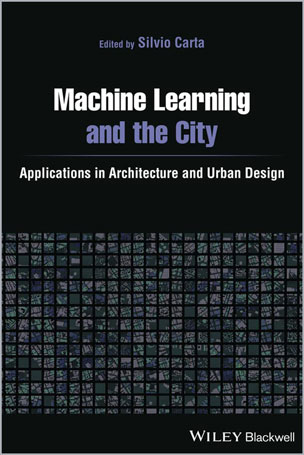
Applications in Architecture and Urban Design
Silvio Carta
#Machine_Learning
#City
#Architecture
#Urban_Design
#AI
Machine Learning and the City
Explore the applications of machine learning and artificial intelligence to the built environment
Machine Learning and the City: Applications in Architecture and Urban Design delivers a robust exploration of machine learning (ML) and artificial intelligence (AI) in the context of the built environment. Relevant contributions from leading scholars in their respective fields describe the ideas and techniques that underpin ML and AI, how to begin using ML and AI in urban design, and the likely impact of ML and AI on the future of city design and planning.
Each section couples theoretical and technical chapters, authoritative references, and concrete examples and projects that illustrate the efficacy and power of machine learning in urban design. The book also includes:
Perfect for designers approaching machine learning and AI for the first time, Machine Learning and the City: Applications in Architecture and Urban Design will also earn a place in the libraries of urban planners and engineers involved in urban design.
Table of Contents
Section I Urban Complexity
1 Urban Complexity
2 Emergence and Universal Computation
3 Fractals and Geography
Project 1 Emergence and Urban Analysis
Project 2 The Evolution and Complexity of Urban St reet Networks
Section II Machines that Think
4 Artificial Intelligence, Logic, and Formalising Common Sense
5 Defining Artificial Intelligence
6 Al: From Copy of Human Brain to Independent Learner
7 The History of Machine Learning and Its Convergent Trajectory Towards Al
8 Machine Behaviour
Project 3 Plan Generation from Program Graph
Project 4 Self-organising Floor Plans in Care Homes
Project 5 N2P2 - Neural Networks and Public Places
Project 6 Urban Fictions
Project 7 Latent Typologies: Architecture in Latent Space
Project 8 Enabling Alternat ive Architectures
Project 9 Distant Readings of Architecture: A Machine View of the City
Section Ill How Machines Learn
9 What Is Machine Learning?
10 Machine Learning: An Applied Mathematics Introduction
11 Machine Learning for Urban Computing
12 Autonomous Artificial Intelligent Agents
Project 10 Machine Learning for Spatial and Visual Connectivity
Project 11 Navigating Indoor Spaces Using Machine Learning: Train Stations in Paris
Project 12 Evolutionary Design Optimisation of Traffic Signals Applied to Quito City
Project 13 Constructing Agency: Self-directed Robotic Environments
Section IV Application to the City
13 Code and the Transduction of Space
14 Augmented Reality in Urban Places: Contested Content and the Duplicity of Code
15 Spatial Data in Urban Informatics: Contentions of the Software-sorted City
16 Urban Morphology Meets Deep Learning: Exploring Urban Forms in One Million Cities, Towns, and Villages Across the Planet
17 Computational Urban Design: Methods and Case Studies
18 lndexical Cities: Personal City Models with Data as Infrastructure
19 Machine Learning, Artificial Intelligence, and Urban Assemblages
20 Making a Smart City Legible
Project 14 A Tale of Many Cities: Universal Patterns in Human Urban Mobility
Project 15 Using Cellular Automata for Parking Recommendations in Smart Environments
Project 16 Gan Hadid
Project 17 Collective Design for Collective Living
Project 18 Architectural Machine Translation
Project 19 Large-scale Evaluation of the Urban Street View with Deep Learning Method
Project 20 Urban Portraits
Project 21 ML-City
Project 22 Imaging Place Using Generative Adversarial Networks (GAN Loci)
Project 23 Urban Forestry Science
Section V Machine Learning and Humans
21 Ten Simple Rules for Responsible Big Data Research
22 A Unified Framework of Five Principles for Al in Society
23 The Big Data Divide and Its Consequences
24 Design Fiction: A Short Essay on Design, Science, Fact, and Fiction
25 Superintelligence and Singularity
Project 25 Emotional Al in Cit ies: Cross-cultural Lessons from the UK and Japan on Designing for an Ethical Life
Project 26 Decoding Urban Inequality: The Applications of Machine Learning for Mapping Inequality in Cit ies of the Global South
Project 27 Amsterdam 2040
Project 28 Committee of Infrastructure
Silvio Carta is an architect and Associate Professor at the University of Hertfordshire, UK. His research interests include digital architecture, data-driven approaches and computational design. Silvio is the author of Big Data, Code and the Discrete City. Shaping Public Realms (Routledge 2019).