ثبت نام / ورود
0
ثبت نام / ورود
0
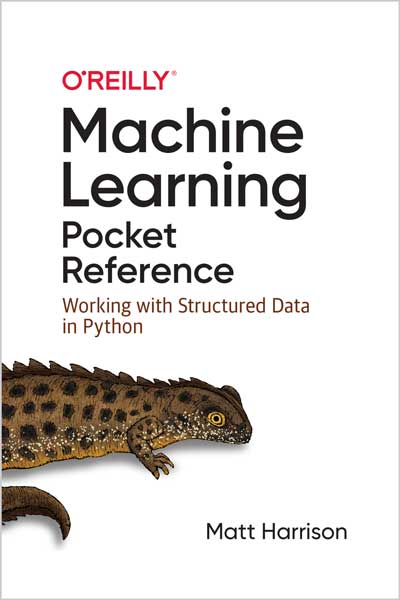
Working with Structured Data in Python
Matt Harrison
#Machine_Learning
#Python
#Data
#data_scientists
#Scikit-learn
#pipelines
With detailed notes, tables, and examples, this handy reference will help you navigate the basics of structured machine learning. Author Matt Harrison delivers a valuable guide that you can use for additional support during training and as a convenient resource when you dive into your next machine learning project.
Ideal for programmers, data scientists, and AI engineers, this book includes an overview of the machine learning process and walks you through classification with structured data. You’ll also learn methods for clustering, predicting a continuous value (regression), and reducing dimensionality, among other topics.
This pocket reference includes sections that cover:
What to Expect
This book gives in-depth examples of solving common structured data problems. It walks through various libraries and models, their trade-offs, how to tune them, and how to interpret them.
The code snippets are meant to be sized such that you can use and adapt them in your own projects.
Who This Book Is For
If you are just learning machine learning, or have worked with it for years, this book should serve as a valuable reference. It assumes some knowledge of Python, and doesn’t delve at all into syntax. Rather it shows how to use various libraries to solve real-world problems.
This will not replace an in-depth course, but should serve as a reference of what an applied machine learning course might cover. (Note: The author uses it as a reference for the data analytics and machine learning courses he teaches.)
About the Author
Matt runs MetaSnake, a Python and Data Science training and consulting company. He has over 15 years of experience using Python across a breadth of domains: Data Science, BI, Storage, Testing and Automation, Open Source Stack Management, and Search.