ثبت نام / ورود
0
ثبت نام / ورود
0
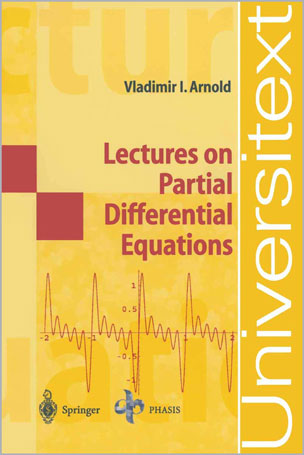
Vladimir I. Arnold
Translator: Roger Cooke
#Lectures
#Partial_Differential_Equations
#Theorem
Like all of Vladimir Arnold's books, this book is full of geometric insight. Arnold illustrates every principle with a figure. This book aims to cover the most basic parts of the subject and confines itself largely to the Cauchy and Neumann problems for the classical linear equations of mathematical physics, especially Laplace's equation and the wave equation, although the heat equation and the Korteweg-de Vries equation are also discussed. Physical intuition is emphasized. A large number of problems are sprinkled throughout the book, and a full set of problems from examinations given in Moscow are included at the end. Some of these problems are quite challenging!
What makes the book unique is Arnold's particular talent at holding a topic up for examination from a new and fresh perspective. He likes to blow away the fog of generality that obscures so much mathematical writing and reveal the essentially simple intuitive ideas underlying the subject. No other mathematical writer does this quite so well as Arnold.
Table of Contents
1 The General Theory for One First-Order Equation
2 The General Theory for One First-Order Equation (Continued)
3 Huygens' Principle in the Theory of Wave Propagation
4 The Vibrating String (d'Alembert's Method)
5 The Fourier Method (for the Vibrating String)
6 The Theory of Oscillations. The Variational Principle
7 The Theory of Oscillations. The Variational Principle (Continued)
8 Properties of Harmonic Functions
9 The Fundamental Solution for the Laplacian. Potentials
10 The Double-Layer Potential
11 Spherical Functions. Maxwell's Theorem. The Removable Singularities Theorem
12. Boundary-Value Problems for Laplace's Equation. Theory of Linear Equations and Systems
A. The Top ological Content of Maxwell's Theorem on the Multifield Representation of Spherical Functions
B. Problems
About the Author
Vladimir I. Arnold was a Soviet and Russian mathematician. He is best known for the Kolmogorov–Arnold–Moser theorem regarding the stability of integrable systems, and contributed to several areas, including geometrical theory of dynamical systems theory, algebra, catastrophe theory, topology, real algebraic geometry, symplectic geometry, symplectic topology, differential equations, classical mechanics, differential geometric approach to hydrodynamics, geometric analysis and singularity theory, including posing the ADE classification problem.
His first main result was the solution of Hilbert's thirteenth problem in 1957 at the age of 19. He co-founded three new branches of mathematics: topological Galois theory (with his student Askold Khovanskii), symplectic topology and KAM theory.
Arnold was also known as a popularizer of mathematics. Through his lectures, seminars, and as the author of several textbooks (such as Mathematical Methods of Classical Mechanics) and popular mathematics books, he influenced many mathematicians and physicists.[5][6] Many of his books were translated into English. His views on education were particularly opposed to those of Bourbaki.