ثبت نام / ورود
0
ثبت نام / ورود
0
Michael Freeman, Oliver R. Goodenough
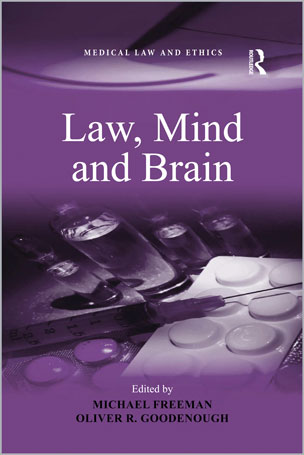
#Law
#Mind
#Brain
#fMRI
Over the past 20 years, cognitive neuroscience has revolutionized our ability to understand the nature of human thought. Working with the understandings of traditional psychology, the new brain science is transforming many disciplines, from economics to literary theory. These developments are now affecting the law and there is an upsurge of interest in the potential of neuroscience to contribute to our understanding of criminal and civil law and our system of justice in general. The international and interdisciplinary chapters in this volume are written by experts in criminal behaviour, civil law and jurisprudence. They concentrate on the potential of neuroscience to increase our understanding of blame and responsibility in such areas as juveniles and the death penalty, evidence and procedure, neurological enhancement and treatment, property, end-of-life choices, contracting and the effects of words and pictures in law. This collection suggests that legal scholarship and practice will be increasingly enriched by an interdisciplinary study of law, mind and brain and is a valuable addition to the emerging field of neurolaw.
Table of Contents
1 Introduction
2 Law, Responsibility and the Brain
3 Brain Imaging and Courtroom Evidence: On the Admissibility and Persuasiveness of fMRI
4 Mind the Gap: Problems of Mind, Body and Brain in the Criminal Law
5 Self-Exclusion Agreements: Should We Be Free not to Be Free to Ruin Ourselves? Gambling, Self-Exclusion Agreements and the Brain
6 The Problems with Blaming
7 Why Distinguish "Mental" and "Physical" Illness in the Law of Involuntary Treatment?
8 A Stable Paradigm: Revisiting Capacity, Vulnerability and the Rights Claims of Adolescents after Roper v. Simmons
9 Thinking Like a Child: Legal Implications of Recent Developments in Brain Research for Juvenile Offenders
10 Legal Implications of Memory-Dampening
11 Reframing the Good Death: Enhancing Choice in Dying, Neuroscience, End-of-Life Research and the Potential of Psychedelics in Palliative Care
12 Equality in Exchange Revisited: From an Evolutionary (Genetic and Cultural) Point of View
13 Just (and Efficient?) Compensation for Governmental Expropriations
14 Examining the Biological Bases of Family Law: Lessons to be Learned for the Evolutionary Analysis of Law
15 Why Do Good People Steal Intellectual Property?
16 Cues in the Courtroom: When Do They Improve Jurors' Decisions?
17 Reflections on Reading: Words and Pictures and Law
'...of interest to both lawyers and medical professionals...[these chapters] contain insights and observations which significantly further the dialogue between law and science in this important area of debate.' New Zealand Medical Journal '...a worthwhile read as a hint to what the future science of the brain may hold for the practice of law.' Law Society Journal '...this excellent treatise not only contains a collection of very interesting papers characterized by in-depth analysis of most relevant aspects of neuroscientific developments, but also corrects a common misunderstanding, according to which only criminal law is challenged by neurosciences.' Journal of Medicine, Health Care and Philosophy 'This book is a perfect fit for medical law and ethics readers. Those in traditional fields of medicine, psychology and law will also find it very useful especially for the depth with which the issues are covered... highly recommended for postgraduate students not only because of the level of readership it was pitched for but mainly because most chapters in this book identify current research gasps in knowledge.' Metapsychology
Michael Freeman is Professor of English Law at University College London. His research interests are in cultural pluralism in particular in relation to the rights of children and in medical ethics particularly in relation to medically assisted reproduction.He has published in the areas of Family Law, Child Law and Policy, Children's Rights, Medicine, Ethics and the Law and Medical Law, Jurisprudence and Legal Theory. He is the author of over 40 books, editor of a large number of international journals and a Fellow of the British Academy.