ثبت نام / ورود
0
ثبت نام / ورود
0
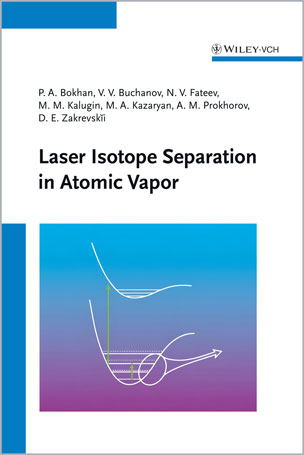
P. A. Bokhan, V. V. Buchanov, N. V. Fateev, M. M. Kalugin, M. A. Kazaryan, A. M. Prokhorov, D. E. Zakrevsk˘ıi
#Laser
#Isotope
#Atomic
#Vapor
#Kinetic_Equations
Wide employment of isotopes in such fields as atomic and thermonuclear power, fundamental science, medicine, biology, isotopic geochronology, Mössbauer spectroscopy, agriculture, activation analysis, ecology, and production of new materials attracts increasing interest in the development of new highly efficient methods for isotope separation.
Modern development of optical spectroscopy, in particular, laser spectroscopy, makes it possible to obtain exhaustive information about the structures and shifts of spectral lines caused by isotopic effects. Recent progress in laser physics, methods of laser frequency tuning, control, and stabilization turns laser sources from laboratory devices to industrial installations. Laser methods for isotope separation have become easier to employ and new possibilities for obtaining isotopically modified and chemically pure substances have been opened. A unique possibility has arisen of not only separating isotopes of various atoms, but also separating isomers and isobars. This is important for mastering the industrial laser isotope separation and for further progress in fundamental investigations including the diagnostic problem of synthesizing new superheavy elements.
Laser isotope separation methods were developed in many countries in the framework of wide programs, first of all in the USA, France, and Japan.Most of the works were devoted to the method of selective photoionization, which was termed AVLIS (atomic vapor laser isotope separation) in these programs. Presently, it is necessary to develop more efficient methods for isotope separation anticipating their competitive ability in economy and ecology. In our opinion it has become possible, first of all, due to the development of laser spectroscopy and laser technique, investigations performed in the field of coherent interaction between radiation and atoms, in particular, the two-photon coherent effects, the nonlinear parametric processes, etc.
One more important feature of the development of modern methods is a great success achieved in studying single-photon and multiphoton light-induced chemical reactions with high rate constants. In this book we present well-known investigations described in numerous publications that were performed by a conventional AVLIS scheme. The aim of this book is to give a general description of the problem of laser isotope separation in atomic vapors. Attention is mainly paid to the development of the photochemical method of isotope separation, which has economical prospects for large-scale industrial production.
Table of Contents
1 Laser Isotope Separation in Atomic Vapors
2 Laser Technique for Isotope Separation
3 Chemical Reactions of Atoms in Excited States
4 Isotope Separation by Single-Photon Isotope-Selective Excitation of Atom
5 Coherent Isotope-Selective Two-Photon Excitation of Atoms
6 Prospects for Industrial Isotope Production by Methods of Laser Isotope Separation
7 Appendix A: Mathematical Description of the Processes Based on Kinetic Equations
8 Appendix B: Operation Features of Copper-Vapor Laser Complexes
9 Appendix C: Physical and Technical Problems of Increasing the Power
of Copper-Vapor Lasers
10 Appendix D: Neutron Transmutation Doping of Silica
11 Appendix E: Employment of Boron Isotopes in Microelectronics
12 Appendix F: Employment of Boron in Nuclear Fuel Cycle Equipment