ثبت نام / ورود
0
ثبت نام / ورود
0
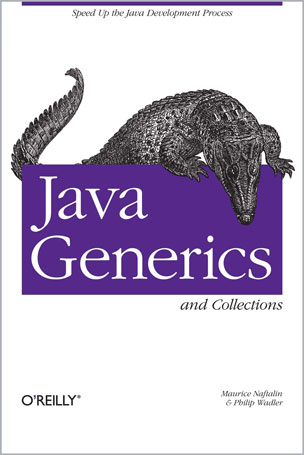
Speed Up the Java Development Process
Maurice Naftalin, Philip Wadler
#Java
#Generics
#Development_Process
This comprehensive guide shows you how to master the most important changes to Java since it was first released. Generics and the greatly expanded collection libraries have tremendously increased the power of Java 5 and Java 6. But they have also confused many developers who haven't known how to take advantage of these new features.
Java Generics and Collections covers everything from the most basic uses of generics to the strangest corner cases. It teaches you everything you need to know about the collections libraries, so you'll always know which collection is appropriate for any given task, and how to use it.
Topics covered include:
Table of Contents
Part I. Generics
Chapter 1. Introduction
Chapter 2. Subtyping and Wildcards
Chapter 3. Comparison and Bounds
Chapter 4. Declarations
Chapter 5. Evolution, Not Revolution
Chapter 6. Reification
Chapter 7. Reflection
Chapter 8. Effective Generics
Chapter 9. Design Patterns
Part II. Collections
Chapter 10. The Main Interfaces of the Java Collections Framework
Chapter 11. Preliminaries
Chapter 12. The Collection Interface
Chapter 13. Sets
Chapter 14. Queues
Chapter 15. Lists
Chapter 16. Maps
Chapter 17. The Collections Class
Maurice Naftalin is Director of Software Development at Morningside Light Ltd., a software consultancy in the United Kingdom. Maurice consults mainly in object-oriented technologies and teaches Java classes part-time at Learning Tree. He has three decades' experience as a programmer, team leader, and commercial trainer.
Philip Wadler is a professor of theoretical computer science at the University of Edinburgh, Scotland, where his research focuses on functional and logic programming. He co-authored the Generic Java standard that became the basis for generics in Sun's Java 5.0 and also contributed to the XQuery language standard base. Professor Wadler received his Ph.D., in computer science from Carnegie-Mellon University and co-wrote "Introduction to Functional Programming" (Prentice-Hall).