ثبت نام / ورود
0
ثبت نام / ورود
0
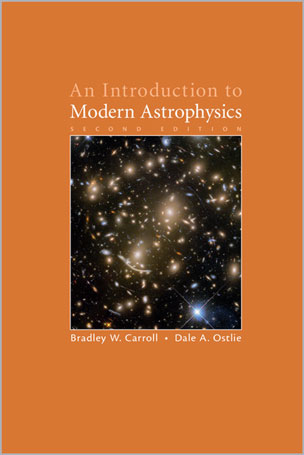
Bradley W. Carroll, Dale A. Ostlie
#Astrophysics
#Black_Holes
#Solar
#Stars
#Cosmology
An Introduction to Modern Astrophysics is a comprehensive, well-organized and engaging text covering every major area of modern astrophysics, from the solar system and stellar astronomy to galactic and extragalactic astrophysics, and cosmology. Designed to provide students with a working knowledge of modern astrophysics, this textbook is suitable for astronomy and physics majors who have had a first-year introductory physics course with calculus. Featuring a brief summary of the main scientific discoveries that have led to our current understanding of the universe; worked examples to facilitate the understanding of the concepts presented in the book; end-of-chapter problems to practice the skills acquired; and computational exercises to numerically model astronomical systems, the second edition of An Introduction to Modern Astrophysics is the go-to textbook for learning the core astrophysics curriculum as well as the many advances in the field.
Table of Contents
Part I. The Tools of Astronomy
1. The Celestial Sphere
2. Celestial Mechanics
3. The Continuous Spectrum of Light
4. The Theory of Special Relativity
5. The Interaction of Light and Matter
6. Telescopes
Part II. The Nature of Stars
7. Binary Systems and Stellar Parameters
8. The Classification of Stellar Spectra
9. Stellar Atmospheres
10. The Interiors of Stars
11. The Sun
12. The Interstellar Medium and Star Formation
13. Main Sequence and Post-Main-Sequence Stellar Evolution
14. Stellar Pulsation
15. The Fate of Massive Stars
16. The Degenerate Remnants of Stars
17. General Relativity and Black Holes
18. Close Binary Star Systems
Part III. The Solar System
19. Physical Processes in the Solar System
20. The Terrestrial Planets
21. The Realms of the Giant Planets
22. Minor Bodies of the Solar System
23. Formation of Planetary Systems
Part IV. Galaxies and the Universe
24. The Milky Way Galaxy
25. The Nature of Galaxies
26. Galactic Evolution
27. The Structure of the Universe
28. Active Galaxies
29. Cosmology
30. The Early Universe
Appendix C. Solar System Data
Appendix D. The Constellations
Appendix E. The Brightest Stars
Appendix F. The Nearest Stars
Appendix G. Stellar Data
Appendix H. The Messier Catalog
Appendix I. Constants, A Programming Module
Appendix J. Orbit, A Planetary Orbit Code
Appendix K. TwoStars, A Binary Star Code
Appendix L. StatStar, A Stellar Structure Code
Appendix M. Galaxy, A Tidal Interaction Code
Appendix N. WMAP Data
Bradley W. Carroll received his B.A. in Mathematics and a Secondary Teaching Credential from the University of California, Irvine, his M.S. in Physics from the University of Colorado, Boulder, and his Ph.D. in Astrophysics from the University of Colorado, Boulder. He then accepted a postdoc with Hugh Van Horn at the University of Rochester and, four years later, accepted a position in the Physics Department at Weber State University, where he served as the Physics Department chair for ten years. He retired in 2015 after thirty years at Weber State University, Utah. During this time, he was awarded the Lowe Innovative Teaching Award and named a WSU Brady Presidential Distinguished Professor. He is an emeritus member of the American Astronomical Society.
Dale A. Ostlie received his B.A. from St. Olaf College in Northfield, Minnesota with degrees in Physics and Mathematics, and his Ph.D. in Astrophysics from Iowa State University. After a two-year teaching position at Bates College in Maine, he moved to Weber State University (WSU), where he worked for thrity years, retiring in 2014. At WSU Dale served as Chair of the Department of Physics for seven years and Dean of the College of Science for eight years. He also served as a collaborator at Los Alamos National Laboratory and worked as an early consultant at the Space Telescope Science Institute. In addition, he has authored or co-authored numerous papers in stellar pulsation theory. While at WSU, Dale was awarded the Lowe Innovative Teaching Award and the Exemplary Collaboration Award. He is a member of the American Astronomical Society.