ثبت نام / ورود
0
ثبت نام / ورود
0
Mark Hindmarsh, Andrew Liddle
#General_Relativity
#Electrodynamics
#Redshift
#Black_holes
#Space_time
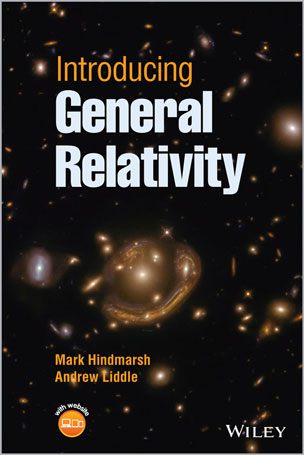
Introducing General Relativity
An accessible and engaging introduction to general relativity for undergraduates
In Introducing General Relativity, the authors deliver a structured introduction to the core concepts and applications of General Relativity. The book leads readers from the basic ideas of relativity―including the Equivalence Principle and curved space-time―to more advanced topics, like Solar System tests and gravitational wave detection.
Each chapter contains practice problems designed to engage undergraduate students of mechanics, electrodynamics, and special relativity. A wide range of classical and modern topics are covered in detail, from exploring observational successes and astrophysical implications to explaining many popular principles, like space-time, redshift, black holes, gravitational waves and cosmology. Advanced topic sections introduce the reader to more detailed mathematical approaches and complex ideas, and prepare them for the exploration of more specialized and sophisticated texts.
Introducing General Relativity also offers:
Perfect for undergraduate physics students who have studied mechanics, dynamics, and Special Relativity, Introducing General Relativity is an essential resource for those seeking an intermediate level discussion of General Relativity placed between the more qualitative books and graduate-level textbooks.
Table of Contents
1 Introducing General Relativity
2 A Special Relativity Reminder
3 Tensors in Special Relativity
4 Towards General Relativity
5 Tensors and Curved Space-Time
6 Describing Matter
7 The Einstein Equation
8 The Schwarzschild Space-time
9 Geodesics and Orbits
10 Tests of General Relativity
11 Black Holes
12 Cosmology
13 Cosmological Models
14 General Relativity: The Next 100 Years
Advanced Topic A 1 Geodesics in the Schwarzschild Space-Time
Advanced Topic A2 The Solar System Tests in Detail
Advanced Topic A3 Weak Gravitational Fields and GravitationalWaves
Advanced Topic A4 GravitationalWave Sources and Detection
Bibliography
Answers to Selected Problems
Mark Hindmarsh is Professor of Theoretical Physics with joint appointments at the University of Sussex, UK and the University of Helsinki, Finland. His research is focused on the physics of the Big Bang, and he is a member of the LISA consortium with particular expertise in the cosmological production of gravitational waves. He has taught at all levels of the undergraduate and postgraduate curriculum.
Andrew Liddle is a Principal Researcher at the University of Lisbon in Portugal, with joint affiliations at the University of Edinburgh, UK, and the Perimeter Institute for Theoretical Physics, Waterloo, Canada. He researches the properties of our Universe and how these relate to fundamental physical laws, especially through understanding astronomical observations. He is involved in several international projects, including the Planck Satellite and the Dark Energy Survey.