ثبت نام / ورود
0
ثبت نام / ورود
0
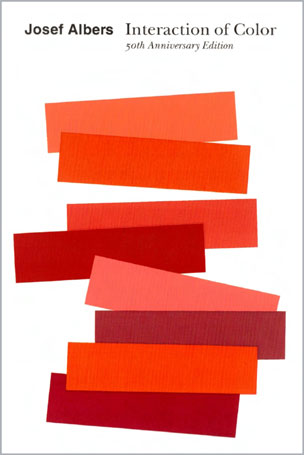
50th Anniversary Edition
Josef Albers
#Color_Theory
#Visual
An experimental approach to the study and teaching of color is comprised of exercises in seeing color action and feeling color relatedness before arriving at color theory.
Table of Contents
I Color recollection-visual memory
II Color reading and contexture
Ill Why color paper-instead of pigment and paint
IV A color has many faces-the relativity of color
V Lighter and/ or darker-light intensity, lightness
VI 1 color appears as 2-looking like the reversed grounds
VII 2 different colors look alike-subtraction of color
VIII Why color deception?-after-image, simultaneous contrast
IX Color mixture in paper-illusion of transparence
X Factual mixtures-additive and subtractive
XI Transparence and space-illusion
XII Optical mixture-after-image revised XI II The Bezold Effect
XIV Color intervals and transformation
XV The middle mixture again-intersecting colors
XVI Color juxtaposition-harmony-quantity
XVI I Film color and volume color-2 natural effects
XVI II Free studies-a challenge to imagination
XIX The Masters-color instrumentation
XX The Weber-Fechner Law-the measure in mixture
XXI From color temperature to humidity in color
XXII Vibrating boundaries
XXIII Equal light intensity-vanishing boundaries
XXIV Color theories-color systems
XXV On teaching color-some color terms
XXVI In lieu of a bibliography-my first collaborators
Josef Albers, one of the most influential artist-educators of the twentieth century, was a member of the Bauhaus group in Germany during the 1920s. In 1933 he came to the United States, where he taught at Black Mountain College for sixteen years. In 1950 he joined the faculty at Yale University as chairman of the department of design. Albers was elected to the National Institute of Arts and Letters in 1968 and was professor emeritus of art at Yale until his death in 1976. Nicholas Fox Weber is executive director of the Josef and Anni Albers Foundation.