ثبت نام / ورود
0
ثبت نام / ورود
0
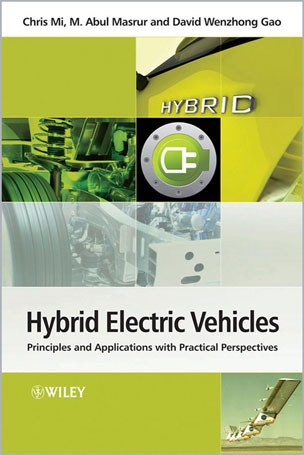
Principles and Applications with Practical Perspectives
Chris Mi, M. Abul Masrur, David Wenzhong Gao
#HEV
#Electric
#Electromechanic
Modern Hybrid Electric Vehicles provides vital guidance to help a new generation of engineers master the principles of and further advance hybrid vehicle technology. The authors address purely electric, hybrid electric, plug-in hybrid electric, hybrid hydraulic, fuel cell, and off-road hybrid vehicle systems. They focus on the power and propulsion systems for these vehicles, including issues related to power and energy management. They concentrate on material that is not readily available in other hybrid electric vehicle (HEV) books such as design examples for hybrid vehicles, and cover new developments in the field including electronic CVT, plug-in hybrid, and new power converters and controls.
Table of Contents
1 Introduction
2 Concept of Hybridization of the Automobile
3 HEV Fundamentals
4 Advanced HEV Architectures and Dynamics of HEV Powertrain
5 Plug-in Hybrid Electric Vehicles
6 Special Hybrid Vehicles
7 HEV Applications for Military Vehicles
8 Diagnostics, Prognostics, Reliability, EMC, and Other Topics Related to HEVs
9 Power Electronics in HEVs
10 Electric Machines and Drives in HEVs
11 Batteries, Ultracapacitors, Fuel Cells, and Controls
12 Modeling and Simulation of Electric and Hybrid Vehicles
13 HEV Component Sizing and Design Optimization
14 Vehicular Power Control Strategy and Energy Management
15 Commercialization and Standardization of HEV Technology
About the Authors
Chris Mi is Associate Professor of Electrical and Computer Engineering and Director of DTE Power Electronics Laboratory at the University of Michigan – Dearborn, Dearborn, MI, USA. Dr Mi is a leading expert in electric and hybrid vehicles, and has presented tutorials and seminars on the subject for the Society of Automotive Engineers (SAE), the IEEE, National Society of Professional Engineers, and major automotive manufacturers and suppliers, including GM, Ford, Chrysler, and Delphi. He has also presented tutorials in China, Korea, Italy, Singapore, and Mexico. He has published more than 100 articles and delivered more than 50 invited talks and keynote speeches, as well as serving as a panelist.
M. Abul Masrur received his PhD in electrical engineering from the Texas A & M University, College Station, TX, USA, in 1984. Dr. Masrur is an Adjunct Professor at the University of Detroit Mercy, where he has been teaching courses on Advanced Electric and Hybrid Vehicles, Vehicular Power Systems, Electric Drives and Power Electronics. He was with the Scientific Research Labs., Ford Motor Co., between 1984 and 2001 and was involved in research and development related to electric drives and power electronics, advanced automotive power system architectures, electric active suspension systems for automobiles, electric power assist steering, and standalone UPS protection design, among other things.
David Wenzhong Gao is an Associate Professor of Electrical and Computer Engineering and Director of Renewable Energy and Power Electronics Laboratory at the University of Denver, Denver, CO, USA. Dr. Gao has conducted extensive research in the areas of hybrid electric vehicles, renewable energy, electric power systems, and smart grids, and has published more than 100 papers in international journals and conference proceedings. He presented a tutorial course “Modeling and Simulation Tools for Vehicle Power System” at the US Army Vetronics Institute in Warren, MI, in 2006. In September 2007, he was elected as a member of Sigma Xi. He is a member of Eta Kappa Nu, the Electrical and Computer Engineering Honor Society, and served as a HKN Faculty Advisor. Since June 2003, he has been a Senior Member of the IEEE. He received the Best Paper Award in the Complex Systems Track at the 2002 Hawaii International Conference on System Sciences (HICSS) in January 2002.