ثبت نام / ورود
0
ثبت نام / ورود
0
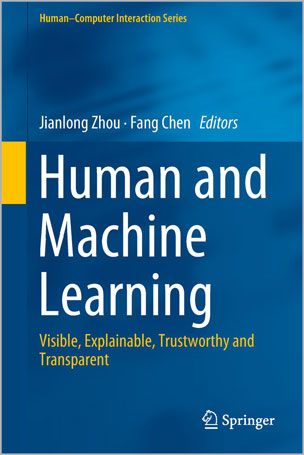
Visible, Explainable, Trustworthy and Transparent
Jianlong Zhou, Fang Chen
#Machine_Learning
#Algorithms
#ML
#DNN
With an evolutionary advancement of Machine Learning (ML) algorithms, a rapid increase of data volumes and a significant improvement of computation powers, machine learning becomes hot in different applications. However, because of the nature of “black-box” in ML methods, ML still needs to be interpreted to link human and machine learning for transparency and user acceptance of delivered solutions. This edited book addresses such links from the perspectives of visualisation, explanation, trustworthiness and transparency. The book establishes the link between human and machine learning by exploring transparency in machine learning, visual explanation of ML processes, algorithmic explanation of ML models, human cognitive responses in ML-based decision making, human evaluation of machine learning and domain knowledge in transparent ML applications.
This is the first book of its kind to systematically understand the current active research activities and outcomes related to human and machine learning. The book will not only inspire researchers to passionately develop new algorithms incorporating human for human-centred ML algorithms, resulting in the overall advancement of ML, but also help ML practitioners proactively use ML outputs for informative and trustworthy decision making.
This book is intended for researchers and practitioners involved with machine learning and its applications. The book will especially benefit researchers in areas like artificial intelligence, decision support systems and human-computer interaction.
Table of Contents
Part I Transparency in Machine Learning
1 2D Transparency Space-Bring Domain Users and Machine Learning Experts Together
2 Transparency in Fair Machine Learning: the Case of Explainable Recommender Systems
3 Beyond Human-in-the-Loop: Empowering End-Users with Transparent Machine Learning
4 Effective Design in Human and Machine Learning: A Cognitive Perspective
5 Transparency Communication for Machine Learning in Human-Automation Interaction
Part II Visual Explanation of Machine Learning Process
6 Deep Learning for Plant Diseases: Detection and Saliency Map Visualisation
7 Critical Challenges for the Visual Representation of Deep Neural Networks
Part Ill Algorithmic Explanation of Machine Learning Models
8 Explaining the Predictions of an Arbitrary Prediction Model: Feature Contributions and Quasi-nomograms
9 Perturbation-Based Explanations of Prediction Models
10 Model Explanation and Interpretation Concepts for Stimulating Advanced Human-Machine Interaction with " Expert-in-the-Loop"
Part IV User Cognitive Responses in ML-Based Decision Making
11 Revealing User Confidence in Machine Learning-Based Decision Making
12 Do I Trust a Machine? Differences in User Trust Based on System Performance
13 Trust of Learning Systems: Considerations for Code, Algorithms, and Affordances for Learning
14 Trust and Transparency in Machine Learning-Based Clinical Decision Support
15 Group Cognition and Collaborative Al
Part V Human and Evaluation of Machine Learning
16 User-Centred Evaluation for Machine Learning
17 Evaluation of Interactive Machine Learning Systems
Part VI Domain Knowledge in Transparent Machine Learning Applications
18 Water Pipe Failure Prediction: A Machine Learning Approach Enhanced By Domain Knowledge
19 Analytical Modelling of Point Process and Application to Transportation
20 Structural Health Monitoring Using Machine Learning Techniques and Domain Knowledge Based Features
21 Domain Knowledge in Predictive Maintenance for Water Pipe Failures
22 Interactive Machine Learning for Applications in Food Science
Jianlong Zhou’s research interests include interactive behaviour analytics, human-computer interaction, machine learning, and visual analytics. He has extensive experience in data driven multimodal cognitive load and trust measurement in predictive decision making. He leads interdisciplinary research on applying visualization and human behaviour analytics in trustworthy and transparent machine learning. He also works with industries in advanced data analytics for transforming data into actionable operations, particularly by incorporating human user aspects into machine learning to translate machine learning into impacts in real world applications.
Fang Chen works in the field of behaviour analytics and machine learning in data driven business solutions. She pioneered the theoretical framework of multimodal cognitive load measurement, and provided much of the empirical evidence on using human behaviour signals and physiological responses to measure and monitor cognitive load. She also leads many taskforces in applying advanced data analytic techniques to help industries make use of data, leading to improved productivity and innovation through business intelligence. Her extensive experience on cognition and machine learning applications across different industries brings unique insights on bridging the gap of machine learning and its impact.