ثبت نام / ورود
0
ثبت نام / ورود
0
A New Aspect of Mathematical Method
Georg Polya
Foreword by: Professor John H. Conway
#Solve
#Mathematical_Method
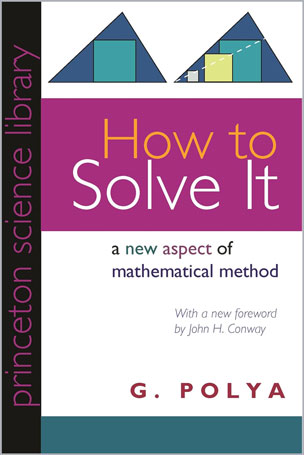
A perennial bestseller by eminent mathematician G. Polya, How to Solve It will show anyone in any field how to think straight. In lucid and appealing prose, Polya reveals how the mathematical method of demonstrating a proof or finding an unknown can be of help in attacking any problem that can be "reasoned" out--from building a bridge to winning a game of anagrams. Generations of readers have relished Polya's deft--indeed, brilliant--instructions on stripping away irrelevancies and going straight to the heart of the problem. In this best-selling classic, George Polya revealed how the mathematical method of demonstrating a proof or finding an unknown can be of help in attacking any problem that can be "reasoned" out--from building a bridge to winning a game of anagrams. Generations of readers have relished Polya's deft instructions on stripping away irrelevancies and going straight to the heart of a problem. How to Solve It popularized heuristics, the art and science of discovery and invention. It has been in print continuously since 1945 and has been translated into twenty-three different languages. Polya was one of the most influential mathematicians of the twentieth century. He made important contributions to a great variety of mathematical research: from complex analysis to mathematical physics, number theory, probability, geometry, astronomy, and combinatorics. He was also an extraordinary teacher--he taught until he was ninety--and maintained a strong interest in pedagogical matters throughout his long career. In addition to How to Solve It, he published a two-volume work on the topic of problem solving, Mathematics of Plausible Reasoning, also with Princeton. Polya is one of the most frequently quoted mathematicians, and the following statements from How to Solve It make clear why: "My method to overcome a difficulty is to go around it." "Geometry is the science of correct reasoning on incorrect figures." "In order to solve this differential equation you look at it till a solution occurs to you."
PART I. IN THE CLASSROOM
Purpose
1. Helping the student
2. Questions, recommendations, mental operations
3. Generality
4. Common sense
5. Teacher and student. Imitation and practice Main divisions, main questions
6. Four phases
7. Understanding the problem
8. Example
g. Devising a plan
10. Example
11. Carrying out the plan
12. Example
13. Looking back
14. Example
15. Various approaches
16. The teacher's method of questioning
17. Good questions and bad questions
More examples
18. A problem of construction
19. A problem to prove
20. A rate problem
PART II. HOW TO SOLVE IT
A dialogue
PART III. SHORT DICTIONARY
OF HEURISTIC
Analogy
Auxiliary elements
Auxiliary problem
Bolzano
Bright idea
Can you check the result?
Can you derive the result differently?
Can you use the result?
Carrying out
Condition
Contradictory
Corollary 73
Could you derive something useful from the data?
Could you restate the problem?
Decomposing and recombining
Definition
Descartes
Determination, hope, success
Diagnosis
Did you use all the data?
Do you know a related problem?
Draw a figure
Examine your guess
Figures
Generalization
Have you seen it before?
Here is a problem related to yours
and solved before
Heuristic
Heuristic reasoning
If you cannot solve the proposed problem
Induction and mathematical induction
Inventor's paradox
Is it possible to satisfy the condition?
Leibnitz
Lemma
Look at the unknown
Modern heuristic
Notation
Pappus
Pedantry and mastery
Practical pro bl ems
Problems to find, problems to prove
Progress and achievement
Puzzles
Reductio ad absurdum and indirect proof
Redundantt
Routine problem
Rules of discovery
Rules of style
Rules of teaching
Separate the various parts of the condition
Setting up equations
Signs of progress
Specialization
Subconscious work
Symmetry
Terms, old and new
Test by dimension
The future mathematician
The intelligent problem-solver
The intelligent reader
The traditional mathematics professor
Variation of the problem
What is the unknown?
Why proofs?
Wisdom of proverbs
Working backwards
PART IV. PROBLEMS, HINTS, SOLUTIONS
Problems
Hints
Solutions