ثبت نام / ورود
0
ثبت نام / ورود
0
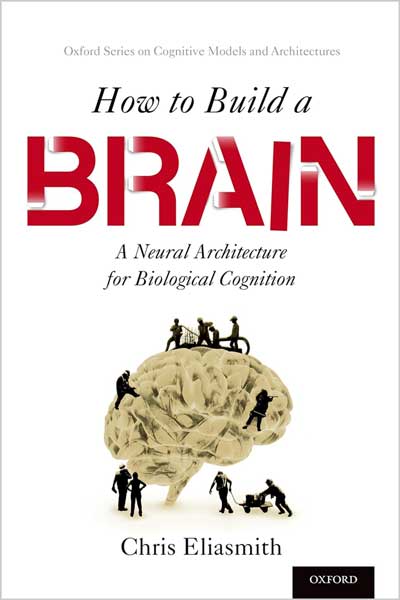
A Neural Architecture for Biological Cognition
Chris Eliasmith
#Brain
#Neural
#Biological
#Neuroscience
#NEF
One goal of researchers in neuroscience, psychology, and artificial intelligence is to build theoretical models that can explain the flexibility and adaptiveness of biological systems. How to Build a Brain provides a guided exploration of a new cognitive architecture that takes biological detail seriously while addressing cognitive phenomena. The Semantic Pointer Architecture (SPA) introduced in this book provides a set of tools for constructing a wide range of biologically constrained perceptual, cognitive, and motor models.
Examples of such models are provided to explain a wide range of data including single-cell recordings, neural population activity, reaction times, error rates, choice behavior, and fMRI signals. Each of the models addressed in the book introduces a major feature of biological cognition, including semantics, syntax, control, learning, and memory. These models are presented as integrated considerations of brain function, giving rise to what is currently the world's largest functional brain model.
The book also compares the Semantic Pointer Architecture with the current state of the art, addressing issues of theory construction in the behavioral sciences, semantic compositionality, and scalability, among other considerations. The book concludes with a discussion of conceptual challenges raised by this architecture, and identifies several outstanding challenges for SPA and other cognitive architectures.
Along the way, the book considers neural coding, concept representation, neural dynamics, working memory, neuroanatomy, reinforcement learning, and spike-timing dependent plasticity. Eight detailed, hands-on tutorials exploiting the free Nengo neural simulation environment are also included, providing practical experience with the concepts and models presented throughout.
Table of Contents
The Science of Cognition
1.1 The Last 50 Years
1.2 How We Got Here
1.3 Where We Are
1.4 Questions and Answers
1.5 Nengo: An Introduction
PART I: HOW TO BUILD A BRAIN
2 An Introduction to Brain Building
3 Biological Cognition: Semantics
4 Biological Cognition-Syntax
5 Biological Cognition-Control
6 Biological Cognition-Memory and Learning
7 The Semantic Pointer Architecture
PART II: IS THAT HOW YOU BUILD A BRAIN?
8 Evaluating Cognitive Theories
9 Theories of Cognition
1 O Consequences and Challenges
A: Mathematical Notation and Overview
B: Mathematical Derivations for the NEF
C: Further Details on Deep Semantic Models
D: Mathematical Derivations for the Semantic Pointer Architecture
E: Semantic Pointer Architecture Model Details
"How to Build a Brain takes on a daunting task, focusing on those parts that we think are important for memory, attention, and planning. Previous attempts at building a cognitive architecture have used symbols or connectionist networks, but Eliasmith uses spiking neurons and models specific brain regions. Categories and semantics emerge from the architecture. The way that all these moving parts work together provides insights into both the nature of cognition and brain function." --Terrence Sejnowski, Professor and Laboratory Head, Computational Neurobiology Laboratory, Howard Hughes Medical Institute Investigator, Francis Crick Chair, Salk Institute "Eliasmith offers a unified theory of cognition that rests on the mechanism of a semantic pointer, namely, a compressed neural representation that can stand as a symbol for a more detailed semantic state or be decompressed to reproduce it, in compositional cognitive processes. Ambitious state-of-the-art modeling grounds the semantic pointer architecture in populations of spiking neurons, providing concrete neural accounts of high-level processes, including attention, learning, memory, syntax, semantics, and reasoning. Along with offering a powerful new approach for integrating cognition and neuroscience, Eliasmith provides detailed technical accounts of his system, with accompanying software that will serve both students and fellow modelers well." --Lawrence W. Barsalou, Professor, Department of Psychology, Emory University
Provides a guided exploration of a new cognitive architecture that takes biological detail seriously while addressing cognitive phenomena. Now in paperback!
Chris Eliasmith is Canada Research Chair in Theoretical Neuroscience at the University of Waterloo.