ثبت نام / ورود
0
ثبت نام / ورود
0
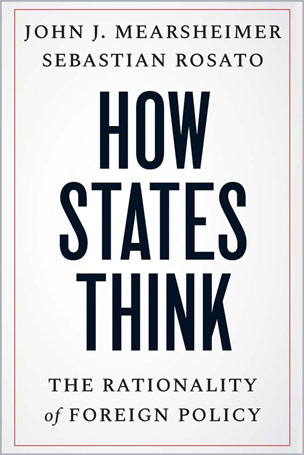
The Rationality of Foreign Policy
John J. Mearsheimer, Sebastian Rosato
#Foreign
#Policy
#Think
#States
#Politics
A groundbreaking examination of a central question in international relations: Do states act rationally?
To understand world politics, you need to understand how states think. Are states rational? Much of international relations theory assumes that they are. But many scholars believe that political leaders rarely act rationally. The issue is crucial for both the study and practice of international politics, for only if states are rational can scholars and policymakers understand and predict their behavior.
John J. Mearsheimer and Sebastian Rosato argue that rational decisions in international politics rest on credible theories about how the world works and emerge from deliberative decision‑making processes. Using these criteria, they conclude that most states are rational most of the time, even if they are not always successful. Mearsheimer and Rosato make the case for their position, examining whether past and present world leaders, including George W. Bush and Vladimir Putin, have acted rationally in the context of momentous historical events, including both world wars, the Cold War, and the post–Cold War era.
By examining this fundamental concept in a novel and comprehensive manner, Mearsheimer and Rosato show how leaders think, and how to make policy for dealing with other states.
Table of Contents
Chapter 1: The Rational Actor Assumption
Chapter 2: Strategic Rationality and Uncertainty
Chapter 3: Defining Strategic Rationality
Chapter 4: Contending Definitions
Chapter 5: Rationality and Grand Strategy
Chapter 6: Rationality and Crisis Management
Chapter 7: Nonrational State Behavior
Chapter 8: Goal Rationality
Chapter 9: Rationality in International Politics
About the Authors
John J. Mearsheimer is the R. Wendell Harrison Distinguished Service Professor of Political Science at the University of Chicago, where he has taught since 1982. He graduated from West Point in 1970 and then served five years as an officer in the U.S. Air Force. He then started graduate school in political science at Cornell University in 1975. He received his Ph.D. in 1980. He spent the 1979-1980 academic year as a research fellow at the Brookings Institution, and was a post-doctoral fellow at Harvard University's Center for International Affairs from 1980 to 1982. During the 1998-1999 academic year, he was the Whitney H. Shepardson Fellow at the Council on Foreign Relations in New York.
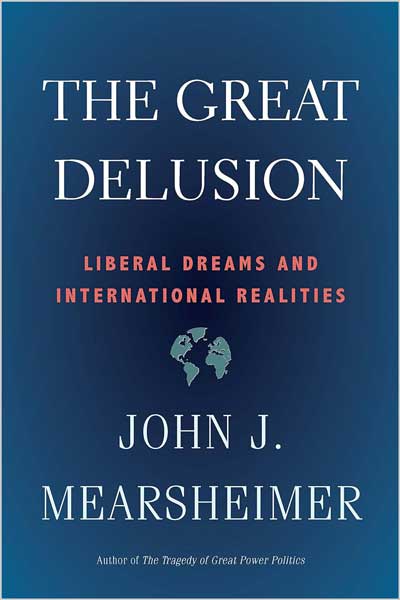
Professor Mearsheimer has written extensively about security issues and international politics more generally. He has published six books: Conventional Deterrence (1983), which won the Edgar S. Furniss, Jr., Book Award; Liddell Hart and the Weight of History (1988); The Tragedy of Great Power Politics (2001, 2014), which won the Joseph Lepgold Book Prize and has been translated into eight different languages; The Israel Lobby and U.S. Foreign Policy (with Stephen M. Walt, 2007), which made the New York Times best seller list and has been translated into twenty-four different languages; Why Leaders Lie: The Truth about Lying in International Politics (2011), which has been translated into twelve different languages; and The Great Delusion: Liberal Dreams and International Realities (2018).
He has also written many articles that have appeared in academic journals like International Security, and popular magazines like Foreign Affairs and the London Review of Books. Furthermore he has written a number of op-ed pieces for the New York Times and the Los Angeles Times dealing with topics like Bosnia, nuclear proliferation, American policy towards India, the failure of Arab-Israeli peace efforts, the folly of invading Iraq, and the causes of the Ukrainian crisis.
Finally, Professor Mearsheimer has won a number of teaching awards. He received the Clark Award for Distinguished Teaching when he was a graduate student at Cornell in 1977, and he won the Quantrell Award for Distinguished Teaching at the University of Chicago in 1985. In addition, he was selected as a Phi Beta Kappa Visiting Scholar for the 1993-1994 academic year. In that capacity, he gave a series of talks at eight colleges and universities. In 2003, he was elected to the American Academy of Arts and Sciences.
Sebastian Rosato is Professor of Political Science at the University of Notre Dame, where he is also a fellow of the Notre Dame International Security Center, the Liu Institute for Asia and Asian Studies, the Kroc Institute for International Peace Studies, and the Nanovic Institute for European Studies. He received a BA (History) from Cambridge University in 1994 and an MPhil (International Relations) from Oxford University in 1996, and then worked for two years at Goldman Sachs International in London. He started graduate school in political science at the University of Chicago in 1998, receiving his MA in 2000 and PhD in 2006.
Professor Rosato was a fellow at Harvard's Olin Institute for Strategic Studies in the 2004-2005 academic year and at Harvard's Belfer Center for International Affairs in 2005-2006. He is also the recipient of fellowships from the Kroc Institute for International Peace Studies, the Nobel Institute, the Earhart Foundation, and the Charles Koch Foundation.
Professor Rosato has written extensively about international politics. He has published three books: Europe United (2011), Intentions in Great Power Politics (2021), and How States Think (2023). He has also written several articles in academic journals, including the American Political Science Review and International Security, on issues in international relations theory.
Professor Rosato has also won two teaching awards. He received the Morton Grodzins Prize Lectureship when he was a graduate student at Chicago, and he won the Reverend Edmund P. Joyce Award for Excellence in Undergraduate Teaching at Notre Dame in 2013.