ثبت نام / ورود
0
ثبت نام / ورود
0
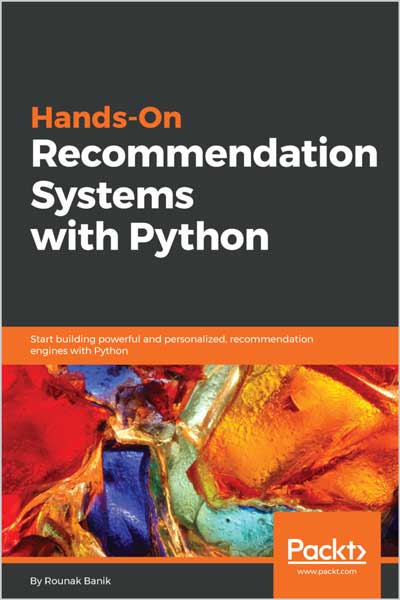
Start building powerful and personalized, recommendation engines with Python
Rounak Banik
#Python
#Recommendation_Systems
#Pandas
#IMDB
Recommendation systems are at the heart of almost every internet business today; from Facebook to Netflix to Amazon.
Providing good recommendations, whether it's friends, movies, or groceries, goes a long way in defining user experience and enticing your customers to use your platform. This book shows you how to do just that.
You will learn about the different kinds of recommenders used in the industry and see how to build them from scratch using Python. No need to wade through tons of machine learning theory—you'll get started with building and learning about recommenders as quickly as possible.. In this book, you will build an IMDB Top 250 clone, a content-based engine that works on movie metadata. You'll use collaborative filters to make use of customer behavior data, and a Hybrid Recommender that incorporates content based and collaborative filtering techniques With this book, all you need to get started with building recommendation systems is a familiarity with Python, and by the time you're finished, you will have a great grasp of how recommenders work and be in a strong position to apply the techniques that you will learn to your own problem domains.
Getting Started with Recommender Systems
Almost everything we buy or consume today is influenced by some form of recommendation; whether that's from friends, family, external reviews, and, more recently, from the sources selling you the product. When you log on to Netflix or Amazon Prime, for example, you will see a list of movies and television shows the service thinks you will like based on your past watching (and rating) history. Facebook suggests people it thinks you may know and would probably like to add. It also curates a News Feed for you based on the posts you've liked, the people you've be-friended, and the pages you've followed.
Amazon recommends items to you as you browse for a particular product. It shows you similar products from a competing source and suggests auxiliary items frequently bought together with the product. So, it goes without saying that providing a good recommendation is at the core of successful business for these companies. It is in Netflix's best interests to engage you with content that you love so that you continue to subscribe to its service; the more relevant the items Amazon shows you, the greater your chances – and volume – of purchases will be, which directly translates to greater profits.
Equally, establishing friendship is key to Facebook's power and influence as an almost omnipotent social network, which it then uses to churn money out of advertising. In this introductory chapter, we will acquaint ourselves with the world of recommender systems, covering the following topics:
What is a recommender system?
Recommender systems are pretty self-explanatory; as the name suggests, they are systems or techniques that recommend or suggest a particular product, service, or entity. However, these systems can be classified into the following two categories, based on their approach to providing recommendations.
Table of Contents
Chapter 1: Getting Started with Recommender Systems Technical requirements
Chapter 2: Manipulating Data with the Pandas Library Technical requirements
Chapter 3: Building an IMDB Top 250 Clone with Pandas Technical requirements
Chapter 4: Building Content-Based Recommenders Technical requirements
Chapter 5: Getting Started with Data Mining Techniques Problem statement
Chapter 6: Building Collaborative Filters Technical requirements
About the Author
Rounak Banik is a Young India Fellow and an ECE graduate from IIT Roorkee. He has worked as a software engineer at Parceed, a New York start-up, and Springboard, an EdTech start-up based in San Francisco and Bangalore. He has also served as a backend development instructor at Acadview, teaching Python and Django to around 35 college students from Delhi and Dehradun. He is an alumni of Springboard's data science career track. He has given talks at the SciPy India Conference and published popular tutorials on Kaggle and DataCamp.