ثبت نام / ورود
0
ثبت نام / ورود
0
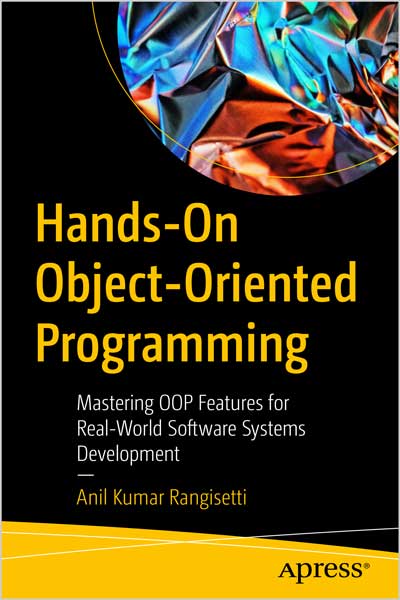
Mastering OOP Features for Real-World Software Systems Development
Anil Kumar Rangisetti
#OOP
#C++
#Python
#Software_Development
Learn how to easily design and implement a software system using object-oriented programming. Through hands-on activities, this book equips you with the real-world practice needed to master OOP skills that can be applied universally across any programming language.
This book is dedicated to bridging the gap between theoretical concepts and practical implementation in software development using OOP. Readers will first understand the importance of OOP in handling software complexities before learning how to model real-world problems through access control, extendible object design, and object relationships. Specifically, the author discusses how to use inheritance, association, and polymorphism concepts for implementing reusable and easy-to-use complex software. More importantly, this book covers design patterns and event-driven programming for learning how to model complex interactions among various objects of the software system to implement various use cases.
Unlike existing books on OOP which teach syntax and semantics through standard examples, this book leverages an immersive learning experience through a variety of real-world use cases, applications, games, and system software. While written in C++, the skills can be applied to any OOP language of the reader's preference. The book's last chapters will quickly introduce Python and Solidity languages for learning advanced technologies. By the end, novice and seasoned developers will know how to implement practical and reusable software systems with confidence.
What You Will Learn
Table of Contents
Chapter 1: The Importance of Object-Oriented Programming
Chapter 2: Start Learning OOP Using C++
Chapter 3: Systematically Starting and Stopping Software Objects
Chapter 4: Exploring Important C++ Features
Chapter 5: Quickly and Systematically Model Real-World Problems into Software
Chapter 6: Quick Software Development Using OOP
Chapter 7: Easy-to-Use Software Development Using OOP
Chapter 8: Design Patterns
Chapter 9: Event-Driven Programming
Chapter 10: A Brief Introduction to OOP in Python and Solidity
About the Author
Dr. Anil Kumar Rangisetti received his PhD in the field of computer science and engineering from IIT Hyderabad. He has 10 years of teaching and research experience in computer science and engineering. During his career, he worked at prestigious Indian institutions such as IIIT Dharwad, SRM-AP, and GMR, and worked at software development and research labs such as ARICENT, IRL-Delhi. Currently he is working as Assistant Professor in the Department of CSE, IIITDM Kurnool. He trained the students in OOP languages, and how to use advanced simulators (NS-3), Docker, and Networking tools for researching and developing applications at his work places. He guided a significant number of undergraduate and postgraduate students for project works.
Broadly, his research interests include Wi-Fi technologies, Next Generation Mobile Networks, SDN, NFV, and Cloud Computing. Besides research activities, he is interested in writing and reviewing books on computer science technologies and programming languages. He published a number of novel research publications with IEEE, Springer, Elsevier, and Wiley in the field of a variety of networking technologies such as LTE, SDN and NFV, and Wi-Fi technologies. He authored a book titled Advanced Network Simulations Simplified.