ثبت نام / ورود
0
ثبت نام / ورود
0
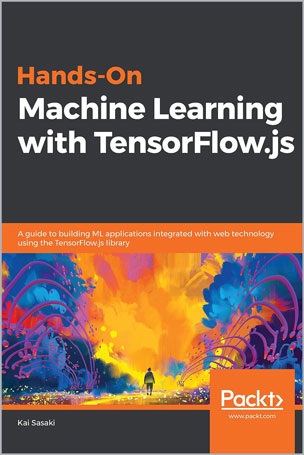
A guide to building ML applications integrated with web technology using the TensorFlow.js library
Kai Sasaki
#Machine_Learning
#TensorFlow.js
#ML
Get hands-on with the browser-based JavaScript library for training and deploying machine learning models effectively
TensorFlow.js is a framework that enables you to create performant machine learning (ML) applications that run smoothly in a web browser. With this book, you will learn how to use TensorFlow.js to implement various ML models through an example-based approach.
Starting with the basics, you'll understand how ML models can be built on the web. Moving on, you will get to grips with the TensorFlow.js ecosystem to develop applications more efficiently. The book will then guide you through implementing ML techniques and algorithms such as regression, clustering, fast Fourier transform (FFT), and dimensionality reduction. You will later cover the Bellman equation to solve Markov decision process (MDP) problems and understand how it is related to reinforcement learning. Finally, you will explore techniques for deploying ML-based web applications and training models with TensorFlow Core. Throughout this ML book, you'll discover useful tips and tricks that will build on your knowledge.
By the end of this book, you will be equipped with the skills you need to create your own web-based ML applications and fine-tune models to achieve high performance.
This book is for web developers who want to learn how to integrate machine learning techniques with web-based applications from scratch. This book will also appeal to data scientists, machine learning practitioners, and deep learning enthusiasts who are looking to perform accelerated, browser-based machine learning on Web using TensorFlow.js. Working knowledge of JavaScript programming language is all you need to get started.
Kai Sasaki works as a software engineer at Treasure Data. He engages in developing largescale distributed systems to make data valuable. His passion for creating artificial intelligence by processing large-scale data led him to the field of machine learning. He is one of the initial contributors to TensorFlow.js and keeps working to add new operators that are required for new types of machine learning models. Because of his work, he received the Google Open Source Peer Bonus in 2018.