ثبت نام / ورود
0
ثبت نام / ورود
0
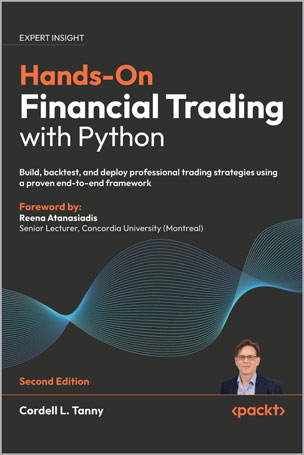
Build, backtest, and deploy professional trading strategies using a proven end-to-end framework
Cordell L. Tanny
#Python
#Trading
#data_analysis
#Matplotlib
#Machine_Learning
#AI
#Financial
Learn algorithmic trading with Python by building one complete strategy, from market data to automated execution. Explore machine learning, AI signals, and rigorous backtesting
Go beyond learning Python libraries in isolation. This book teaches you the complete workflow professionals use to build systematic trading strategies.
You start by acquiring, exploring, and cleaning market data, handling missing values, misaligned time series, and noise. From there, you form trading hypotheses, generate signals, and define entry and exit rules. You evaluate risk-adjusted performance and challenge your backtests through out-of-sample testing and walk-forward analysis. Next, you explore time-series models, machine learning for trading, and AI-driven alpha signal generation. Finally, you build a deployable strategy repository and automate execution in the cloud. One volatility tail-hedge strategy runs from raw data to cloud deployment, and you build five further strategies from published research, covering momentum, regime detection, economic indicators, and sector rotation, each tested to confirm that its signal does real work.
Drawing on 25 years of institutional trading experience, the book shows you how to spot lookahead bias and overfitting and distinguish promising signals from noise. You work with VectorBT and QuantStats, with PythonAnywhere for deployment. The book includes all the code, and by the end you have working strategies and a repeatable framework for algorithmic trading with Python
This book is for traders going systematic, data scientists entering quantitative finance, and portfolio managers automating their workflows. Whether you are building your first complete strategy or moving beyond isolated Python scripts, you share one frustration: books that teach tools but not how to put them together. This book gives you that missing piece.
You should be comfortable with basic Python, including functions, loops, and working in Jupyter notebooks, and with finance fundamentals such as returns, volatility, and risk.
Part 1. Foundations and Data
Chapter 1. Introducing Algorithmic Trading
Chapter 2. Setting up a Python Quantitative Workflow
Chapter 3. Data Retrieval
Chapter 4. Understanding Exploratory Data Analysis
Chapter 5. Data Preparation
Chapter 6. Removing Noise From Financial Data
Part 2. Evaluating and Validating Strategies
Chapter 7. Evaluating Strategy Performance
Chapter 8. Understanding Backtesting
Chapter 9. Out-of-Sample Testing
Chapter 10. Walk-Forward Analysis
Chapter 11. How to Spot a Bad Backtest
Part 3. Forecasting and Rules-Based Strategies
Chapter 12. Time-Series Models
Chapter 13. Algorithmic Trading Strategies
Part 4. Machine Learning and AI Signals
Chapter 14. Climbing the Machine Learning Ladder
Chapter 15. Machine Learning in Practice
Chapter 16. AI as an Alpha Signal Generator
Chapter 17. Building a Deployable Strategy Repository
Chapter 18. Running Your Strategy Without You
Chapter 19. Unlock the Code Bundle and the PDF Version
Appendix A. Asset Class Overview
Appendix B. Cheat Sheets and Checklists
Appendix C. Data Provider Resources
Cordell Tanny possesses over 25 years of expertise in designing and deploying algorithmic trading systems for institutional markets. Leveraging a B.Sc. in Biology from McGill University, he applies a scientific, hypothesis-driven methodology to finance. He held senior roles at Standard Life Investments and RBC, overseeing a $2 billion CAD multi-asset program. Cordell is a CFA Charterholder, Certified FRM, and holds the FDP charter. Currently a quantitative consultant, he architects bespoke Python-based trading infrastructures and machine learning models for investment firms. He lectures at Concordia University and develops comprehensive online curricula on systematic trading. He frequently addresses CFA Societies on the technical implementation of AI strategies.