ثبت نام / ورود
0
ثبت نام / ورود
0
Leila Patel, Sophie Plagerson, Isaac Chinyoka
#Social
#Protection
#Development
#Global_South
#COVID-19
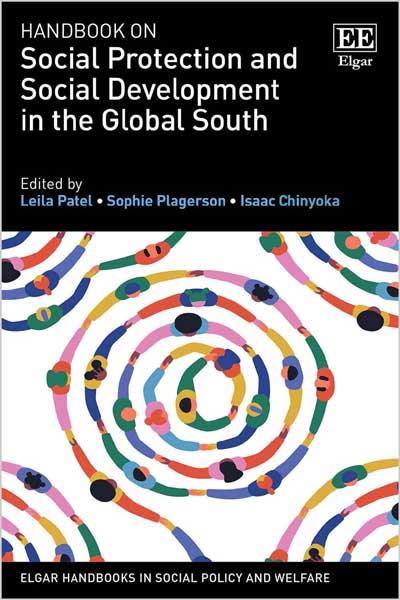
This cutting-edge Handbook argues for social protection to be situated in a wider system of social welfare and development programmes for low- and middle-income countries. Focusing on the role of citizens and communities in enhancing human development, it explores how welfare systems are unfolding in diverse contexts across the global South.
Tracing the evolution and theory of social protection, the Handbook examines the nature, design, scope, goals and linkages of social protection and social development programmes. Case studies examine responses to the COVID-19 pandemic; the entrepreneurial character of modern social protection schemes; cash transfer schemes and the move towards cash-plus policies; and the fluidity between progression and regression of social protection. With global and regional reviews of social protection from in-country experts, the Handbook provides innovative solutions to key challenges.
Bridging theoretical and empirical approaches, the Handbook on Social Protection and Social Development in the Global South will prove an invaluable resource for academics and graduate students of development, social policy and sociology. Its comprehensive overview of the field will also be useful for policymakers and practitioners working on social welfare and development in the global South.
Table of Contents
PART I THE NEXUS BETWEEN SOCIAL PROTECTION, SOCIAL WELFARE AND THE SOCIAL DEVELOPMENT APPROACH
1. The social development approach to social protection and social welfare
2. A social contract approach to social protection: its potential and limitations
3. The politics of social protection in the global South
PART II NATURE, SCOPE AND GOALS OF SOCIAL PROTECTION: GLOBAL AND REGIONAL OVERVIEWS
4. The state of social protection around the world
5. Social protection in Latin America
6. Social protection in Africa
7. Social protection in Southeast Asia
8. Social protection systems in MENA: past, present and future
PART Ill DESIGN FEATURES OF SOCIAL PROTECTION AND INSTITUTIONAL CAPABILITY
9. Social protection systems and their linkages
10. Universal, categorical and targeted social protection: issues, debates and solutions
11. Social protection modes of financing and capability challenges in low- and middle-income countries
12. Evaluating social protection policies
13. Social protection impacts, gaps and future research
14. Understanding the role of nutrition-sensitive social protection interventions in child nutritional outcomes
PART V SOCIAL PROTECTION LINKAGES AND INNOVATIONS
15. Linking social protection with complementary services: approaches and country innovations
16. Social protection for workers in the informal economy: opportunities and constraints for informal worker -led schemes
17. Financial capability and asset building: innovations in social protection and development
18. Linking formal and informal social protection in an insecurity regime: The case of Zimbabwe
19. The role of social work in the delivery of conditional cash transfer programmes: lessons from Chile
20. Public employment programmes and their interface with social protection
PART VI SOCIAL PROTECTION, VULNERABILITIES AND SOCIAL INCLUSION: LINKAGES WITH SOCIAL WELFARE SERVICES AND DEVELOPMENT SYSTEMS
21. Cash plus programmes for children and families in eastern and southern Africa: examples from practice and lessons learnt
22. Gender and social protection in Brazil
23. Social security for persons with disabilities across low- and middle-income countries: an overview on lessons learnt and pathways toward greater inclusivity
24. Social protection for refugees and asylum seekers: a South African case study
PART VII COUNTRY RESPONSES TO COVID-19
25. Global rapid appraisal of social protection responses to COVID-19
26. The digital delivery of welfare services in India: Achievements, anomalies and lessons learnt
27. Social protection responses to COVID-19 in Indonesia
28. Safeguarding vulnerable children in China during COVID-19 and beyond: an integrated approach to social protection and social governance
29. Social protection responses to COVID-19 in South Africa
‘This Handbook is a very important contribution to further our collective understanding of social protection. Showcasing how countries, including in low-income settings, have prioritized investments and followed differentiated pathways towards the realization of the right to social protection, it reaffirms the importance of context-specific processes, political economy dynamics and innovation. And precisely because of these differentiated pathways, social protection continues to demonstrate its central role for children’s wellbeing, elimination of multidimensional child poverty, enhancing equity, preparedness and social cohesion, and critically, accelerating human development results across the life cycle in times of crises, recovery and peace.’ -- Natalia Winder-Rossi, Global Director of Social Policy and Social Protection, UNICEF