ثبت نام / ورود
0
ثبت نام / ورود
0
A. Zee
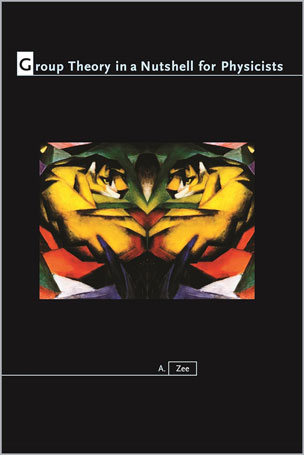
#Group
#Theory
#Nutshell
#Physicists
#SO(N)
#SO(4)
#Quantum
#Frobenius
#Lagrangian
A concise, modern textbook on group theory written especially for physicists
Although group theory is a mathematical subject, it is indispensable to many areas of modern theoretical physics, from atomic physics to condensed matter physics, particle physics to string theory. In particular, it is essential for an understanding of the fundamental forces. Yet until now, what has been missing is a modern, accessible, and self-contained textbook on the subject written especially for physicists.
Group Theory in a Nutshell for Physicists fills this gap, providing a user-friendly and classroom-tested text that focuses on those aspects of group theory physicists most need to know. From the basic intuitive notion of a group, A. Zee takes readers all the way up to how theories based on gauge groups could unify three of the four fundamental forces. He also includes a concise review of the linear algebra needed for group theory, making the book ideal for self-study.
Table of Contents
I Part I: Groups: Discrete or Continuous, Finite or Infinite
I.1 Symmetry and Groups
I.2 Finite Groups
I.3 Rotations and the Notion of Lie Algebra
II Part II: Representing Group Elements by Matrices
II.1 Representation Theory
II.2 Schur’s Lemma and the Great Orthogonality Theorem
II.3 Character Is a Function of Class
II.4 Real, Pseudoreal, Complex Representations, and the Number of Square Roots
II.i1 Crystals Are Beautiful
II.i2 Euler’s ϕ-Function, Fermat’s Little Theorem, and Wilson’s Theorem II.i3 Frobenius Groups
III Part III: Group Theory in a Quantum World
III.1 Quantum Mechanics and Group Theory: Parity, Bloch’s Theorem, and the Brillouin Zone
III.2 Group Theory and Harmonic Motion: Zero Modes
III.3 Symmetry in the Laws of Physics: Lagrangian and Hamiltonian
IV Part IV: Tensor, Covering, and Manifold
IV.1 Tensors and Representations of the Rotation Groups SO(N)
IV.2 Lie Algebra of SO(3) and Ladder Operators: Creation and Annihilation
IV.3 Angular Momentum and Clebsch-Gordan Decomposition
IV.4 Tensors and Representations of the Special Unitary Groups SU(N)
IV.5 SU(2): Double Covering and the Spinor
IV.6 The Electron Spin and Kramer’s Degeneracy
IV.7 Integration over Continuous Groups, Topology, Coset Manifold, and SO(4)
IV.8 Symplectic Groups and Their Algebras
IV.9 From the Lagrangian to Quantum Field Theory: It Is but a Skip and a Hop
IV.i1 Multiplying Irreducible Representations of Finite Groups: Return to the Tetrahedral Group
IV.i2 Crystal Field Splitting
IV.i3 Group Theory and Special Functions
IV.i4 Covering the Tetrahedron
V Part V: Group Theory in the Microscopic World
V.1 Isospin and the Discovery of a Vast Internal Space
V.2 The Eightfold Way of SU(3) 312
V.3 The Lie Algebra of SU(3) and Its Root Vectors
V.4 Group Theory Guides Us into the Microscopic World
VI Part VI: Roots, Weights, and Classification of Lie Algebras
VI.1 The Poor Man Finds His Roots
VI.2 Roots and Weights for Orthogonal, Unitary, and Symplectic Algebras
VI.3 Lie Algebras in General 364
VI.4 The Killing-Cartan Classification of Lie Algebras
VI.5 Dynkin Diagrams
VII Part VII: From Galileo to Majorana
VII.1 Spinor Representations of Orthogonal Algebras
VII.2 The Lorentz Group and Relativistic Physics
VII.3 SL(2,C) Double Covers SO(3,1): Group Theory Leads Us to the Weyl Equation
VII.4 From the Weyl Equation to the Dirac Equation
VII.5 Dirac and Majorana Spinors: Antimatter and Pseudoreality
VII.i1 A Hidden SO(4) Algebra in the Hydrogen Atom
VII.i2 The Unexpected Emergence of the Dirac Equation in Condensed Matter Physics
VII.i3 The Even More Unexpected Emergence of the Majorana Equation in Condensed Matter Physics
VIII Part VIII: The Expanding Universe
VIII.1 Contraction and Extension
VIII.2 The Conformal Algebra
VIII.3 The Expanding Universe from Group Theory
IX Part IX: The Gauged Universe
IX.1 The Gauged Universe
IX.2 Grand Unification and SU(5)
IX.3 From SU(5) to SO(10)
IX.4 The Family Mystery
A. Zee is professor of physics at the Kavli Institute for Theoretical Physics at the University of California, Santa Barbara. His books include Quantum Field Theory in a Nutshell, Einstein Gravity in a Nutshell, and Fearful Symmetry: The Search for Beauty in Modern Physics (all Princeton).