ثبت نام / ورود
0
ثبت نام / ورود
0
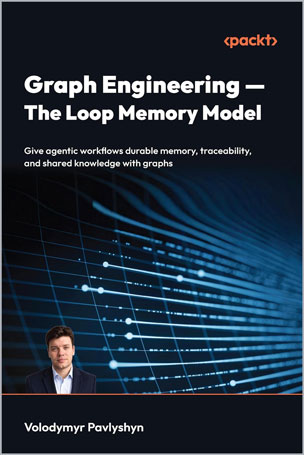
Give agentic workflows durable memory, traceability, and shared knowledge with graphs
Volodymyr Pavlyshyn
#Graph_Engineering
#Loop
#AI
#DAG
#NEAR
Give agentic systems a memory that survives every run by turning decisions, evidence, and execution history into durable, traceable graph structures
Agent loops are good at producing work, but the reasoning behind that work disappears the moment the context window closes. Two agents rediscover the same bug three sprints apart; a decision made in run 12 gets silently contradicted in run 47.
Graph Engineering moves that reasoning out of transcripts and into an explicit knowledge graph. You'll model execution history separately from durable knowledge, then connect the two with a small set of bridge relationships. Markdown stays the authoritative source; the graph is a disposable index built for queries, not a second source of truth.
From there, the book turns the model into a working mechanism: parse structured repository data, extract only genuine prose, resolve entities, and assemble typed relations. Retrieve small, relevant neighborhoods instead of dumping an entire knowledge base into context. See how evaluations check supporting paths, how concurrent workers publish changes without corrupting shared state, and how a pipeline preserves lineage from objective to artifact.
The final section is judgment; which metrics reveal graph quality, how false merges and bad incentives produce confident errors, what this architecture costs, and when a simple ADR log or relational table is the better answer.
This book is for senior software engineers, AI and agent engineers, software architects, and platform teams already experimenting with agent loops, coding agents, or multi-agent workflows. It is most useful when decisions, constraints, evidence, and execution history need to survive across runs or be shared between workers. Prior books in the Clarity series are helpful but not required; the manuscript recaps the lattice before extending it. Readers should be comfortable reasoning about software architecture and structured engineering workflows.
Table of Contents
Part I. The Argument
Chapter 1. Everyone's Building Loops, Almost Nobody's Building the One That Remembers
Chapter 2. The Ladder: Five Architectures, Five Bottlenecks
Chapter 3. Two Graphs, Not One
Part II. The Structure
Chapter 4. The Lattice You Already Have
Chapter 5. Lattice Metagraphs
Chapter 6. Semantic Spacetime for the Lattice
Chapter 7. The Schema
Part III. The Mechanism
Chapter 8. Building the Graph
Chapter 9. Context Assembly and the Grounded Evaluator
Chapter 10. The Swarm Against One Graph
Chapter 11. The Pipeline, Rewired
Part IV. Judgement
Chapter 12. Metrics, Failure Modes, and When Not to Build This
Chapter 13. The Build Path
Chapter 14. Further Reading
Appendix A. Graph Engineering on One Page
Appendix B. Schema Reference
Appendix C. The Prompts
Volodymyr Pavlyshyn writes about AI-driven software engineering, agent workflows, and durable engineering knowledge. Graph Engineering is the third book in his Clarity series, following The Clarity Engineer and The Clarity Forge. Across the series, he explores how engineering judgment, specifications, architecture records, and agent execution can be turned into explicit artifacts that survive tool and model changes. In this book, he extends that work from durable specifications to graph-based memory for multi-agent development.