ثبت نام / ورود
0
ثبت نام / ورود
0
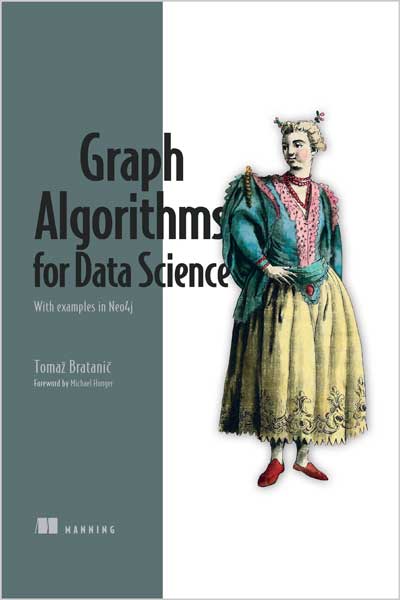
With examples in Neo4j
Tomaž Bratanic
#Graph_Algorithms
#Data_Science
#Neo4j
#CSV
#SQL
Practical methods for analyzing your data with graphs, revealing hidden connections and new insights.
Graphs are the natural way to represent and understand connected data. This book explores the most important algorithms and techniques for graphs in data science, with concrete advice on implementation and deployment. You don’t need any graph experience to start benefiting from this insightful guide. These powerful graph algorithms are explained in clear, jargon-free text and illustrations that makes them easy to apply to your own projects.
Graphs are the natural way to understand connected data. This book explores the most important algorithms and techniques for graphs in data science, with practical examples and concrete advice on implementation and deployment. In Graph Algorithms for Data Science you will learn:Labeled-property graph modeling Constructing a graph from structured data such as CSV or SQL NLP techniques to construct a graph from unstructured data Cypher query language syntax to manipulate data and extract insights Social network analysis algorithms like PageRank and community detection How to translate graph structure to a ML model input with node embedding models Using graph features in node classification and link prediction workflows Graph Algorithms for Data Science is a hands-on guide to working with graph-based data in applications like machine learning, fraud detection, and business data analysis. It's filled with fascinating and fun projects, demonstrating the ins-and-outs of graphs. You'll gain practical skills by analyzing Twitter, building graphs with NLP techniques, and much more.
You don't need any graph experience to start benefiting from this insightful guide. These powerful graph algorithms are explained in clear, jargon-free text and illustrations that makes them easy to apply to your own projects. about the technology Graphs reveal the relationships in your data. Tracking these interlinking connections reveals new insights and influences and lets you analyze each data point as part of a larger whole.
This interconnected data is perfect for machine learning, as well as analyzing social networks, communities, and even product recommendations. about the book Graph Algorithms for Data Science teaches you how to construct graphs from both structured and unstructured data. You'll learn how the flexible Cypher query language can be used to easily manipulate graph structures, and extract amazing insights. The book explores common and useful graph algorithms like PageRank and community detection/clustering algorithms. Each new algorithm you learn is instantly put into action to complete a hands-on data project, including modeling a social network! Finally, you'll learn how to utilize graphs to upgrade your machine learning, including utilizing node embedding models and graph neural networks.
In Graph Algorithms for Data Science you will learn:
Graph Algorithms for Data Science is a hands-on guide to working with graph-based data in applications like machine learning, fraud detection, and business data analysis. It’s filled with fascinating and fun projects, demonstrating the ins-and-outs of graphs. You’ll gain practical skills by analyzing Twitter, building graphs with NLP techniques, and much more.
Foreword by Michael Hunger.
About the technology
A graph, put simply, is a network of connected data. Graphs are an efficient way to identify and explore the significant relationships naturally occurring within a dataset. This book presents the most important algorithms for graph data science with examples from machine learning, business applications, natural language processing, and more.
About the book
Graph Algorithms for Data Science shows you how to construct and analyze graphs from structured and unstructured data. In it, you’ll learn to apply graph algorithms like PageRank, community detection/clustering, and knowledge graph models by putting each new algorithm to work in a hands-on data project. This cutting-edge book also demonstrates how you can create graphs that optimize input for AI models using node embedding.
What's inside
About the reader
For data scientists who know machine learning basics. Examples use the Cypher query language, which is explained in the book.
Table of Contents
PART 1 INTRODUCTION TO GRAPHS
1 Graphs and network science: An introduction
2 Representing network structure: Designing your first graph model
PART 2 SOCIAL NETWORK ANALYSIS
3 Your first steps with Cypher query language
4 Exploratory graph analysis
5 Introduction to social network analysis
6 Projecting monopartite networks
7 Inferring co-occurrence networks based on bipartite networks
8 Constructing a nearest neighbor similarity network
PART 3 GRAPH MACHINE LEARNING
9 Node embeddings and classification
10 Link prediction
11 Knowledge graph completion
12 Constructing a graph using natural language processing technique
'The book covers topics in-depth but is easy to understand. Though delving into theory, it doesn't lose its focus of being a more practical guide. ' Carl Yu 'A good starting point to getting started with network analysis and how to extract the essential information you need easily.' Andrea Paciolla
'A great introduction to how to use graphs and data they can provide.' Marcin Sęk
Tomaž Bratanic is a network scientist at heart, working at the intersection of graphs and machine learning. He has applied these graph techniques to projects in various domains including fraud detection, biomedicine, business-oriented analytics, and recommendations.