ثبت نام / ورود
0
ثبت نام / ورود
0
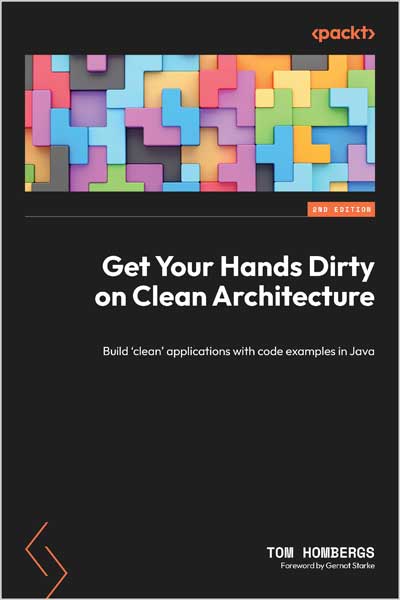
Build ‘clean’ applications with code examples in Java
Tom Hombergs
#Architecture
#Java
#Clean_code
Gain insight into how Hexagonal Architecture can help to increase maintainability.
Building for maintainability is key to keep development costs low (and developers happy). The second edition of "Get Your Hands Dirty on Clean Architecture" is here to equip you with the essential skills and knowledge to build maintainable software.
Building upon the success of the first edition, this comprehensive guide explores the drawbacks of conventional layered architecture and highlights the advantages of domain-centric styles such as Robert C. Martin's Clean Architecture and Alistair Cockburn's Hexagonal Architecture. Then, the book dives into hands-on chapters that show you how to manifest a Hexagonal Architecture in actual code. You'll learn in detail about different mapping strategies between the layers of a Hexagonal Architecture and see how to assemble the architecture elements into an application. The later chapters demonstrate how to enforce architecture boundaries, what shortcuts produce what types of technical debt, and how, sometimes, it is a good idea to willingly take on those debts.
By the end of this second edition, you'll be armed with a deep understanding of the Hexagonal Architecture style and be ready to create maintainable web applications that save money and time. Whether you're a seasoned developer or a newcomer to the field, "Get Your Hands Dirty on Clean Architecture" will empower you to take your software architecture skills to new heights and build applications that
stand the test of time.
This book is for you if you care about the architecture of the software you are building. To get the most out of this book, you must have some experience with web development. The code examples in this book are in Java. If you are not a Java programmer but can read object-oriented code in other languages, you will be fine. In the few places where Java or framework specifics are needed, they are thoroughly explained.
"The foundation of clean architecture has been documented under different names (Hexagonal Architecture, Ports and Adapters, Clean Architecture, and Onion Architecture). The core idea is always the same: putting the domain code in the center and "protecting" it from technical code by creating clear boundaries. Dependencies point "inward" toward the domain code. However, most sources on this topic are vague and abstract, leaving too much room for interpretation and guessing. Tom's book fills this gap by guiding you toward a highly maintainable and clear architectural structure with lots of concrete examples and diagrams."
Gernot Starke, Software Architect, Founder of arc42, Cofounder of iSAQB
Tom Hombergs is a software engineer by profession and by passion with more than a decade of experience working on many different software projects for many different clients across various industries. In software projects, he takes on the roles of software developer, architect, and coach, with a focus on the Java ecosystem. He has found that writing is the best way to learn, so he likes to dive deep into topics he encounters in his software projects to create texts that give structure to the chaotic world of software development. He regularly writes about software development on his blog and is an occasional speaker at conferences.