ثبت نام / ورود
0
ثبت نام / ورود
0
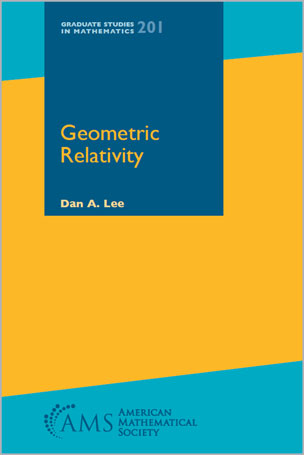
Dan A. Lee
#Geometric
#Relativity
#Riemannian
#Spacetime
The mathematics of general relativity is a large and active field, says Lee, and he wants to introduce students to just one part of it: problems in general relativity that are essentially geometric in character, that is, that can be addressed using the methods of Riemannian geometry and partial differential equations. Even that is a lot, so he narrows his treatment further to focus on the positive mass theorem and the various ideas that surround it and have grown from it. It is about understanding the interplay between mass, scalar curvature, minimal surfaces, and related concepts. He assumes a working understanding of Riemannian geometry, and basic knowledge of elliptic linear partial differential equations, especially Sobolev spaces.
Table of Contents
Part 1. Riemannian geometry
Chapter 1. Scalar curvature
Chapter 2. Minimal hypersurfaces
Chapter 3. The Riemannian positive mass theorem
Chapter 4. The Riemannian Penrose inequality
Chapter 5. Spin geometry
Chapter 6. Quasi-local mass
Part 2. Initial data sets
Chapter 7. Introduction to general relativity
Chapter 8. The spacetime positive mass theorem
Chapter 9. Density theorems for the constraint equations
Review
'Geometric Relatively' is refreshing in its narrative approach to this topic. The author is open and honest about the material included and the material excluded in the text, explaining when certain material is omitted or glossed over. Indeed, oftentimes finer technical details will be omitted from a proof for the sake of narrative clarity. Overall, this book is a nice textbook for a graduate student to study from or a great reference for a research mathematician. Anyone who is interested in exploring relativity from a geometry perspective or simply interested purely in geometric analysis can gain something from this text. --John Ross, Southwestern University