ثبت نام / ورود
0
ثبت نام / ورود
0
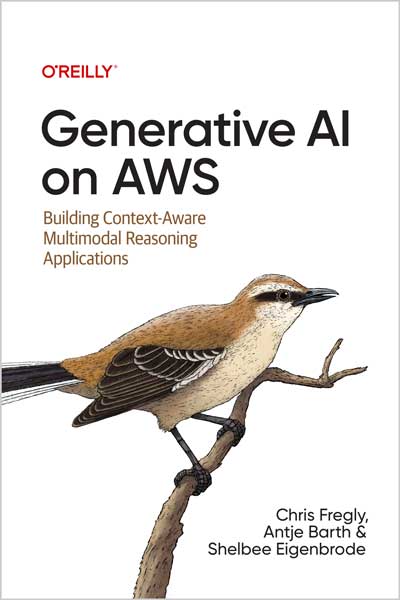
Building Context-Aware Multimodal Reasoning Applications
Chris Fregly, Antje Barth, and Shelbee Eigenbrode
#AI
#AWS
#ML
#AWS
#LoRA
#RAG
#RLHF
Companies today are moving rapidly to integrate generative AI into their products and services. But there's a great deal of hype (and misunderstanding) about the impact and promise of this technology. With this book, Chris Fregly, Antje Barth, and Shelbee Eigenbrode from AWS help CTOs, ML practitioners, application developers, business analysts, data engineers, and data scientists find practical ways to use this exciting new technology.
You'll learn the generative AI project life cycle including use case definition, model selection, model fine-tuning, retrieval-augmented generation, reinforcement learning from human feedback, and model quantization, optimization, and deployment. And you'll explore different types of models including large language models (LLMs) and multimodal models such as Stable Diffusion for generating images and Flamingo/IDEFICS for answering questions about images.
Table of Contents
Chapter 1. Generative Al Use Cases, Fundamentals, and Project Life Cycle
Chapter 2. Prompt Engineering and In-Context Learning
Chapter 3. Large-Language Foundation Models
Chapter 4. Memory and Compute Optimizations
Chapter 5. Fine-Tuning and Evaluation
Chapter 6. Parameter-Efficient Fine-Tuning
Chapter 7. Fine-Tuning with Reinforcement Learning from Human Feedback
Chapter 8. Model Deployment Optimizations
Chapter 9. Context-Aware Reasoning Applications Using RAG and Agents
Chapter 10. Multi modal Foundation Models
Chapter 11. Controlled Generation and Fine-Tuning with Stable Diffusion
Chapter 12. Amazon Bedrock: Managed Service for Generative Al
After reading this book, you will understand the most common generative AI use cases and tasks addressed by industry and academia today. You will gain in-depth knowledge of how these cutting-edge generative models are built, as well as practical experience to help you choose between reusing an existing generative model or building one from scratch. You will then learn to adapt these generative AI models to your domain-specific datasets, tasks, and use cases that support your business applications.
This book is meant for AI/ML enthusiasts, data scientists, and engineers who want to learn the technical foundations and best practices for generative AI model training, fine-tuning, and deploying into production. We assume that you are already familiar with Python and basic deep-learning components like neural networks, forward propagation, activations, gradients, and back propagations to understand the concepts used here.
A basic understanding of Python and deep learning frameworks such as TensorFlow or PyTorch should be sufficient to understand the code samples used throughout the book. Familiarity with AWS is not required to learn the concepts, but it is useful for some of the AWS-specific samples.
You will dive deep into the generative AI life cycle and learn topics such as prompt engineering, few-shot in-context learning, generative model pretraining, domain adaptation, model evaluation, parameter-efficient fine-tuning (PEFT), and reinforcement learning from human feedback (RLHF).
You will get hands-on with popular large language models such as Llama 2 and Falcon as well as multimodal generative models, including Stable Diffusion and IDEFICS. You will access these foundation models through the Hugging Face Model Hub, Amazon SageMaker JumpStart, or Amazon Bedrock managed service for generative AI.
You will also learn how to implement context-aware retrieval-augmented generation (RAG) and agent-based reasoning workflows. You will explore application frameworks and libraries, including LangChain, ReAct, and Program-Aided-Language models (PAL). You can use these frameworks and libraries to access your own custom data sources and APIs or integrate with external data sources such as web search and partner data systems.
Lastly, you will explore all of these generative concepts, frameworks, and libraries in the context of multimodal generative AI use cases across different content modalities such as text, images, audio, and video.
And don’t worry if you don’t understand all of these concepts just yet. Throughout the book, you will dive into each of these topics in much more detail. With all of this knowledge and hands-on experience, you can start building cutting-edge generative AI applications that help delight your customers, outperform your competition, and increase your revenue!
About the Author
Chris Fregly is a Principal Solutions Architect for generative AI at Amazon Web Services and coauthor of Data Science on AWS (O’Reilly).
Antje Barth is Principal Developer Advocate for generative AI at Amazon Web Services and coauthor of Data Science on AWS.
Shelbee Eigenbrode is a Principal Solutions Architect for generative AI at Amazon Web Services. She holds over 35 patents across various technology domains.