ثبت نام / ورود
0
ثبت نام / ورود
0
F J Duarte
#Quantum
#Feynman's_Hamiltonians
#Bell's_theorem
#Einstein
#Podolsky
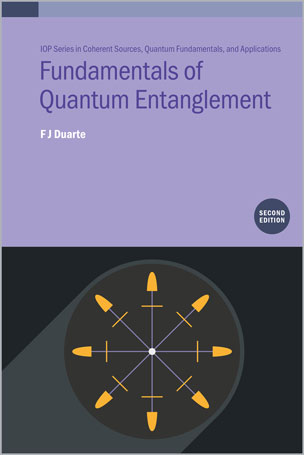
Quantum Entanglement has rapidly become a subject of great interest in academia, industry, and government research institutions. This book builds on the first edition of Fundamentals of Quantum Entanglement to provide a transparent and more insightful introduction for graduate students, scientists, and engineers. It is also a highly useful education tool for those practitioners that were not aware of the physical origin of quantum entanglement: the Dirac-Wheeler-Pryce-Ward physics. The new edition includes an expansion on topics such as quantum entropy and quantum time. The book provides a direct, practical, and transparent introduction to the principles and physics of quantum entanglement. It does so whilst utilizing an interferometric approach based on Dirac-Feynman superposition probability amplitudes.
Key Features:
While good wines and cheeses get better with age, good books require more human intervention. The second edition of Fundamentals of Quantum Entanglement makes an excellent book into an even better one. The second edition has a similar structure to the first, with relatively short and dense but easy-to-follow chapters, most of them packed with advanced math, and all of them including multiple chapter references (many published by the book author). The second edition includes a new chapter on quantum entanglement via matrix notation, as well as many additional sections in the existing chapters. To help the reader digest the sometimes daunting math treatment, the book is illustrated with diagrams and charts (some in color, although not much benefitting from color) and mapped out around a fairly extensive index. While the first edition was already an excellent reference for those interested in quantum entanglement, the second edition could equally well be used as a textbook, because each chapter includes a set of problems.
Bogdan Hoanca, Optica, October 2023
Table of Contents
1. Introduction
2. Dirac's physics
3. The Einstein–Podolsky–Rosen (EPR) paper
4. The Schrödinger papers
5. Wheeler's paper
6. The probability amplitude for quantum entanglement
7. The quantum entanglement experiment
8. The annihilation quantum entanglement experiments
9. The Bohm and Aharonov paper
10. Bell's theorem
11. Feynman's Hamiltonians
12. The second Wu quantum entanglement experiment
13. The hidden variable theory experiments
14. The optical quantum entanglement experiments
15. The quantum entanglement probability amplitude 1947–1992
16. The GHZ probability amplitudes
17. The interferometric derivation of the quantum entanglement probability amplitude for n = N = 2
18. The interferometric derivation of the quantum entanglement probability amplitude for n = N = 2¹, 2², 2³, 2⁴… 2ʳ
19. The interferometric derivation of the quantum entanglement probability amplitudes for n = N = 3, 6
20. Quantum entanglement at n = 1 and N = 2
21. Quantum entanglement probability amplitudes applied to Bell's theorem
22. Quantum entanglement via matrix notation
23. Cryptography via quantum entanglement
24. Quantum entanglement and teleportation
25. Quantum entanglement and quantum computing
26. Space-to-space and space-to-Earth communications via quantum entanglement
27. Space-to-space quantum interferometric communications
28. Quanta pair sources for quantum entanglement experiments
29. Quantum interferometric principles
30. On the interpretation of quantum mechanics
Appendix A. Revisiting the Pryce–Ward probability amplitude for quantum entanglement
Appendix B. Classical and quantum interference
Appendix C. Interferometers and their probability amplitudes
Appendix D. Polarization rotators for quantum entanglement
Appendix E. Vectors, vector products, matrices, and tensors for quantum entanglement
Appendix F. Trigonometric identities
Appendix G. More on quantum notation
Appendix H. From quantum principles to classical optics
Appendix I. Introduction to complex conjugates and Hamilton's quaternions
Appendix J. Some open ended quantum questions
About the Author
F J Duarte is a laser physicist, quantum physicist, inventor, and author. He introduced the generalized multiple-prism-grating dispersion theory, has discovered a number of tunable laser oscillator configurations, pioneered the use of Dirac's quantum notation in interferometry and classical optics, applied quantum mechanics to industrial imaging, discovered coherent light sheet illumination, demonstrated coherent emission from electrically-pumped organic semiconductors, derived the quantum entanglement probability amplitude from transparent quantum interferometric principles, and arrived at Newton's second law from quantum mechanics, in only a few lines.
His physics has been applied to numerous fields from astronomy to spectroscopy, from atomic physics to laser isotope separation, from biology to medicine, from laser pulse compression to laser cavity design, from nanophotonics to nanoengineering, and from quantum entanglement to quantum philosophy.
Currently, Duarte's attention focuses on the foundations of quantum entanglement, and their impact on our perception of reality. He also works on the physics of high-power tunable lasers and on the application of Dirac's quantum notation to laser interferometers and classical optics.
Duarte was born in Santiago de Chile, and his research physics career began at Macquarie University (Sydney, Australia), where he was the first to graduate with first class honours in physics. At Macquarie he was also a student of the celebrated quantum physicist J C Ward. In the United States he has worked in the academic, industrial, and defense sectors. In 2000, with Oxford physicist R H Dalitz, he wrote: "Already in 1948, observations... agreed with quantum mechanics, not with local realism."